
40%
Energy Saving vs Brick-Lined
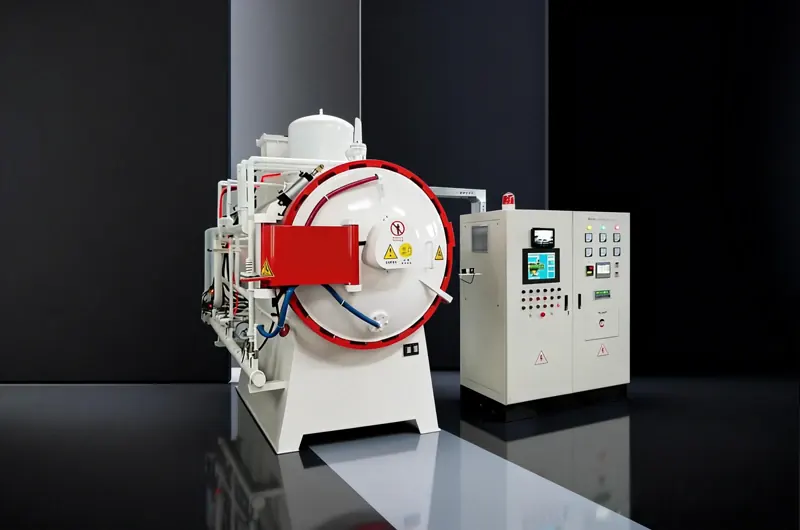
Tempering is the essential step after quenching — relieving internal stress, stabilizing microstructure, and restoring toughness. Doing it under vacuum ensures the bright, clean surface achieved during vacuum quenching is never compromised by re-oxidation.
After vacuum quenching, your workpiece has a bright, oxide-free surface and precise dimensional control. Tempering in an open-air furnace re-introduces oxygen at elevated temperature — undoing the surface quality achieved in the quenching step and requiring additional cleaning or grinding.
This vacuum tempering furnace uses the same molybdenum rod heating elements and multi-layer stainless steel radiation shield construction as our vacuum annealing furnace — maintaining a 7×10⁻³ Pa vacuum environment throughout the entire tempering cycle. The result is a complete, all-vacuum heat treatment chain with no atmospheric exposure at any stage.
The 51-segment programmable temperature controller manages heating rate, soak temperature, soak time, and cooling rate with ±3°C accuracy — critical for multi-stage tempering processes where each cycle must hit a precise temperature window.
A vacuum tempering furnace is rarely purchased alone — it completes the heat treatment chain started by a vacuum quenching furnace. Brother Furnace offers matched quenching and tempering systems designed to work together, sharing the same chamber size range and control platform.
Heat to hardening temperature under vacuum, then quench with 1–10 bar variable-pressure nitrogen or argon gas. Ideal for tool steels, die steels, and carbon-sensitive alloys. Parts exit bright and distortion-minimized.
View Vacuum Gas Quenching FurnaceFor steels requiring faster quench rates than gas can provide — tool steels, high-speed steels, bearing steels. Dual-chamber design keeps heating and quench environments fully separated.
View Vacuum Oil Quenching FurnaceImmediately after quenching, temper under 7×10⁻³ Pa vacuum to relieve stress, stabilize microstructure, and restore toughness — without any re-oxidation of the quenched surface. This is the furnace you are viewing now.
get quoteA common concern with high-temperature furnaces used for low-temperature tempering is whether temperature uniformity can be maintained at the lower end of the operating range. At 150–300°C, radiant heat transfer is significantly less effective than at high temperatures.
This furnace addresses that directly. The molybdenum rod element array is configured to provide uniform radiant heat distribution across the full chamber volume at all operating temperatures. The 51-segment PLC controller manages power delivery precisely to maintain ±5°C uniformity whether you are running a 180°C low-temperature temper for high-carbon steel or a 650°C high-temperature temper for alloy structural steel.
For processes requiring even tighter low-temperature uniformity — such as precision aerospace components or medical implants — contact our engineering team to discuss forced convection options for the specific temperature range you need.
Starting-point parameters for common materials processed in our vacuum tempering furnaces. Final parameters should be validated against your specific part geometry, section thickness, and target mechanical properties.
| Material | Grade Examples | Tempering Range | Temp. Range | Cycles | Target Property |
|---|---|---|---|---|---|
| High-speed steel | M2, M42, T1 | Low | 540–560°C × 3 | 3 cycles | HRC 63–66, retained austenite decomposition |
| Hot-work tool steel | H13, H11, H21 | Medium–High | 550–650°C | 2 cycles | HRC 44–52, high toughness |
| Cold-work tool steel | D2, D3, Cr12MoV | Low–Medium | 150–200°C | 2 cycles | HRC 58–62, wear resistance |
| Plastic mold steel | P20, 718, NAK80 | Medium | 480–520°C | 2 cycles | HRC 28–34, machinability |
| Spring steel | 65Mn, 60Si2Mn | Medium | 400–500°C | 1 cycle | High elastic limit, fatigue resistance |
| Alloy structural steel | 4140, 4340, 42CrMo | High | 550–650°C | 1 cycle | High toughness, quench & temper (Q&T) |
| PH stainless steel | 17-4PH, 15-5PH | Medium | 480–620°C (aging) | 1 cycle | Precipitation hardening, HRC 28–44 |
| Titanium alloy | TC4, TA15 | Medium | 480–560°C (aging) | 1 cycle | Aging strengthening after solution treatment |
Parameters shown are starting-point references only. Always validate against material certifications and your specific hardness or toughness targets.
Vacuum tempering is not just about surface protection — it also eliminates the risk of hydrogen embrittlement and ensures process repeatability that open-air furnaces cannot guarantee.
Open-air tempering re-oxidizes the bright surface achieved during vacuum quenching. Vacuum tempering keeps the entire heat treatment chain oxide-free — no additional cleaning, grinding, or shot blasting required.
High-speed steels require three consecutive tempering cycles. The 51-segment program controller executes each cycle identically — same temperature ramp, same soak time, same cooling rate — eliminating batch-to-batch variation.
Unlike salt-bath or atmosphere tempering, vacuum processing eliminates all hydrogen sources. Parts that are susceptible to hydrogen embrittlement — high-strength steels, titanium alloys — can be safely tempered without any risk of hydrogen uptake.
Salt-bath tempering requires molten nitrate salts at operating temperature, creating fire risk, toxic fume exposure, and hazardous waste disposal costs. Vacuum tempering eliminates all of these — cleaner process, safer workplace.
| Criterion | Vacuum Tempering | Open-Air Furnace | Salt Bath |
|---|---|---|---|
| Surface re-oxidation | None | Significant | Low |
| Post-temper cleaning | Not required | Sometimes required | Required |
| Hydrogen embrittlement risk | None | Low | Low |
| Temperature uniformity | ±5°C | ±10–15°C typical | ±5°C |
| Process repeatability | Excellent (PLC program) | Moderate | Moderate |
| Environmental / safety | Clean, no hazardous waste | Acceptable | Toxic salt, fire risk |
Every component is selected to deliver consistent, repeatable tempering results across the full service life of the furnace.
Zero carbon emission at any temperature. Excellent dimensional stability and long service life — the same heating element used in our vacuum annealing furnace for process consistency across your heat treatment line.
All-metal insulation with zero outgassing. Maintains clean vacuum integrity throughout the tempering cycle — no organic binders, no contamination risk for reactive or high-purity alloys.
Real-time heating curve display, process program storage, and alarm management on a single color LCD touchscreen. Create and store multiple tempering programs for different materials and cycle counts.
Up to 51 independently configurable segments per program — accommodating multi-stage tempering cycles, including the three-cycle protocol required for high-speed steels, all within a single stored program.
High-strength carbon steel with acid wash, phosphating, and electrostatic powder coating. Outer shell surface stays below 50°C during full-power operation — safe to approach and inspect at any time.
Automates the complete cycle from pump-down through heating, soaking, and cooling. Safety interlocks, fault diagnostics, and alarm logging are hardware-independent of the main temperature controller.
All furnace sizes share identical performance ratings. Chamber dimensions and load capacity scale with the size you select.
All sizes deliver identical performance specifications. Select by your largest workpiece envelope and target batch weight. Custom sizes up to 1.8 × 3 m are available.
| Chamber Size | Heating Zone (W×H×D) mm | Est. Load Capacity | Power | Power Supply | Ultimate Vacuum |
|---|---|---|---|---|---|
| Small BR-QHM-223 |
200 × 200 × 300 | ~30 kg | 42 kW | 380V | 7×10⁻³ Pa |
| Medium-Small BR-QHM-334 |
300 × 300 × 400 | ~80 kg | 72 kW | 380V | 7×10⁻³ Pa |
| Medium BR-QHM-446 |
400 × 400 × 600 | ~200 kg | 120 kW | 380V | 7×10⁻³ Pa |
| Medium-Large BR-QHM-557 |
500 × 500 × 700 | ~350 kg | 160 kW | 380V | 7×10⁻³ Pa |
| Large BR-QHM-669 |
600 × 600 × 900 | ~600 kg | 225 kW | 380V | 7×10⁻³ Pa |
Load capacity values are estimates based on chamber volume. Actual capacity depends on workpiece geometry and loading configuration. Custom chamber sizes up to 1.8 × 3 m are available — contact our engineering team with your workpiece drawings.
Answers to the questions our customers ask most often about the vacuum tempering furnace.
Yes. Since this furnace shares the same molybdenum rod heating elements and multi-layer stainless steel radiation shield construction as our vacuum annealing furnace, it is technically capable of performing both processes. The 51-segment programmable controller allows you to store both tempering and annealing programs. However, for high-volume production lines where tempering is a dedicated step after quenching, we recommend a dedicated tempering furnace to optimize cycle times and workflow.
This vacuum tempering furnace is designed to be the second step in a complete vacuum heat treatment chain. After parts are quenched in our vacuum gas quenching furnace (BR-QCL) or vacuum oil quenching furnace (BR-YCL), they are transferred to this tempering furnace for stress relief and toughness restoration. Both furnaces share the same chamber size range (up to 600 × 600 × 900 mm standard, 1.8 × 3 m custom) and the same PLC control platform, ensuring seamless integration and operator familiarity.
Yes. The 51-segment programmable controller can accommodate multiple tempering cycles within a single stored program. For example, high-speed steels typically require three tempering cycles at 540–560°C. You can program the furnace to heat to temperature, soak, cool to room temperature, and then repeat the cycle two more times — all without operator intervention. This ensures consistent results and frees up operator time for other tasks.
Typical utility requirements are as follows. Exact values depend on the furnace size selected:
A full site preparation checklist is provided upon order confirmation.
All vacuum tempering furnaces are covered by a 2-year warranty on the complete machine. Brother Furnace provides on-site installation and commissioning, operator training, and a spare parts package with each unit. Remote diagnostics and extended service contracts are available upon request.
Vacuum tempering is suitable for virtually all tool steels, die steels, high-speed steels, bearing steels, spring steels, and alloy structural steels that require post-quench stress relief and toughness restoration. It is particularly valuable for materials where surface oxidation during tempering would be problematic — including titanium alloys, nickel superalloys, PH stainless steels, and any component where the bright surface finish achieved during vacuum quenching must be preserved through the entire heat treatment chain.
Cycle time depends on the material, target temperature, section thickness, and number of tempering cycles required. As a general reference, a single tempering cycle for tool steel at 500°C — including pump-down, heating, soaking, and furnace cooling to a safe unloading temperature — typically takes 3 to 5 hours. High-speed steels requiring three consecutive cycles will naturally extend total cycle time. The 51-segment programmable controller allows all cycles to be chained into a single automated program, minimizing operator involvement and maximizing furnace utilization.
Distortion during tempering is primarily caused by non-uniform heating and rapid thermal gradients. The all-round molybdenum rod element arrangement provides radiant heating from multiple directions simultaneously, ensuring the entire load heats evenly without localized hot spots. The programmable heating profile allows slow ramp rates and intermediate soak stages to be inserted for large or complex cross-sections, allowing thermal equilibrium to be reached before the target temperature is applied. Controlled furnace cooling further reduces thermal shock during the cooling stage.
Yes, routine maintenance ensures stable vacuum performance and long service life. Recommended maintenance includes monthly inspection of mechanical pump oil levels, quarterly oil changes for the mechanical pump, annual inspection of all O-ring seals and gaskets, and periodic cleaning of the vacuum chamber interior. The furnace is designed for straightforward on-site maintenance — all serviceable components are accessible without special tooling. Full maintenance schedules, checklists, and replacement part specifications are provided in the user manual supplied with every unit.
Yes. The PLC-based control system supports storage of multiple independent process programs, each with up to 51 configurable segments covering heating rate, soak temperature, soak time, and cooling rate. Operators can create and store dedicated recipes for each material and tempering specification — for example, separate programs for H13 double tempering, M2 triple tempering, and 17-4PH aging — and recall them instantly via the touchscreen HMI. Full process data including temperature curves, vacuum levels, and alarm events is logged automatically for every cycle and can be exported via USB for quality records.