
40%
Energy Saving vs Brick-Lined
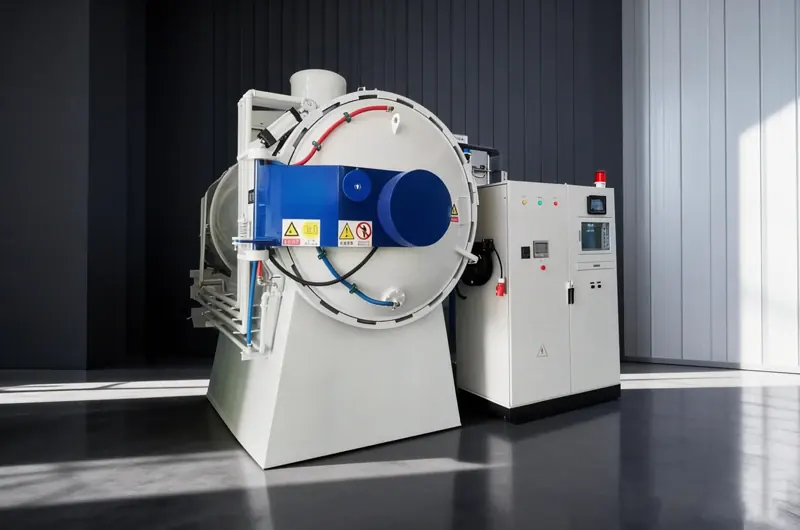
The vacuum oil quenching furnace combines a graphite heating chamber with an integrated oil-and-gas cooling system. Parts are heated under high vacuum, then transferred automatically into the quench chamber — delivering clean, bright surfaces and minimized distortion that open-atmosphere furnaces cannot achieve.
The furnace uses high-purity graphite tube heating elements housed within a graphite felt insulation chamber. The high degree of automation in the electronic control system ensures repeatable, stable results across every cycle — whether you are running a single prototype or a full production batch.
The dual-chamber architecture keeps the heating environment completely separate from the quench media. Workpieces are heated and soaked in the rear chamber, then transferred by the lifting skip car into the front chamber for oil quenching or gas cooling — all without breaking vacuum or exposing parts to atmosphere.
The furnace is divided into two functionally independent chambers sharing a single vacuum envelope. This separation prevents quench media contamination of the heating zone and allows precise, independent control of each process stage.
The rear chamber houses the graphite hot zone. Workpieces are loaded here, heated to the target temperature under high vacuum, and held at temperature for the required soak time before transfer.
The upper section of the front chamber provides gas cooling for materials that do not require oil quenching. The gas cooling cover uses a staggered-teeth flange structure to ensure reliable sealing under both positive and negative pressure.
The lower section of the front chamber contains the oil quench tank, lifting skip car, oil mixing system, and oil heating device. After soaking in the rear chamber, the workpiece is transferred and lowered into the oil at controlled speed.
Every subsystem is engineered to minimize operator intervention and maximize repeatability across the full service life of the furnace.
High-purity graphite tubes provide excellent thermal uniformity and resistance to thermal shock. Long service life reduces downtime and maintenance cost compared to wire-wound elements.
The multi-layer graphite felt insulation panels deliver superior heat retention and trapping efficiency, reducing energy consumption and improving temperature uniformity across the entire working zone.
The screw-and-nut driven lifting mechanism provides three operating speeds: low-speed loading, high-speed oil quench entry, and low-speed final positioning — ensuring smooth, controlled workpiece transfer at every stage.
A reducer-driven mixer with internal deflector promotes uniform oil circulation throughout the quench tank. Consistent oil flow eliminates local hot spots and ensures repeatable quench severity across every batch.
The gas cooling cover uses a staggered-teeth flange structure that maintains reliable sealing under both positive and negative pressure conditions — critical for safe operation during gas backfill and cooling cycles.
The electronic control system automates the full process cycle — from heating and soaking to transfer and quench. Stable, reliable operation reduces operator dependency and ensures consistent results batch after batch.
All furnace sizes share identical performance ratings. Chamber dimensions and load capacity scale with the size you select.
All sizes deliver identical performance specifications. Select by your largest workpiece envelope and target batch weight.
| Chamber Size | Inner Dimensions (W×H×D) mm | Max Load | Installed Power | Ultimate Vacuum | Typical Application |
|---|---|---|---|---|---|
| Small BR-YCL-334 |
300 × 300 × 450 | 100 kg | 50 kW | 7×10⁻¹ Pa | R&D samples, small tooling, prototype batches |
| Medium-Small BR-YCL-446 |
400 × 400 × 600 | 200 kg | 80 kW | 7×10⁻¹ Pa | Cutting tools, bearing components, medical instruments |
| Medium BR-YCL-557 |
500 × 500 × 700 | 300 kg | 120 kW | 7×10⁻¹ Pa | Medium molds, high-speed steel batch production |
| Medium-Large BR-YCL-669 |
600 × 600 × 900 | 500 kg | 150 kW | 7×10⁻¹ Pa | Large die sets, structural components, spring steel batches |
| Large BR-YCL-8812 |
800 × 800 × 1200 | 900 kg | 260 kW | 7×10⁻¹ Pa | Heavy molds, large aerospace forgings, high-volume production |
Custom chamber dimensions and configurations are available. Contact our engineering team with your workpiece drawings for a tailored recommendation.
The dual-chamber vacuum oil quenching furnace serves a broad range of industries where surface cleanliness, dimensional accuracy, and metallurgical consistency are critical.
Bright hardening of H13, D2, M2, and P20 steels with minimal distortion and no surface scale.
Consistent through-hardening of bearing steel rings and races with tight dimensional tolerances.
Hardening and annealing of high-alloy structural components where surface integrity is non-negotiable.
Vacuum sintering of cemented carbide cutting inserts and technical ceramics in a controlled atmosphere.
Hardening and stress-relief annealing of spring steel components with consistent mechanical properties.
Vacuum brazing of complex metal assemblies requiring clean, flux-free joints with high bond strength.
Answers to the questions our customers ask most often about the vacuum oil quenching furnace.
In conventional oil quenching, parts are heated in an open atmosphere, which causes surface oxidation and decarburization before the quench even begins. Vacuum oil quenching heats parts under high vacuum (7×10⁻¹ Pa), completely eliminating oxygen and moisture from the heating environment. The result is a bright, oxide-free surface finish that requires no post-process cleaning or grinding — while still delivering the fast quench rates that oil provides for hardenability-critical steels.
The dual-chamber design keeps the heating environment completely isolated from the quench media. The rear chamber maintains a clean vacuum atmosphere for heating and soaking. The front chamber contains the oil quench tank and gas cooling zone. Workpieces are transferred between chambers by the automated lifting skip car without ever being exposed to atmosphere — preserving surface quality throughout the entire process cycle.
Yes. The front chamber provides both options. The upper section is the gas cooling zone; the lower section is the oil quench tank. The appropriate quench method is selected based on the material and the required cooling rate. Materials that need rapid quenching for full hardness use oil; materials that require slower, more controlled cooling can use the gas cooling option.
Typical utility requirements are as follows. Exact values depend on the furnace size selected:
A full site preparation checklist is provided upon order confirmation.
All vacuum oil quenching furnaces are covered by a 2-year warranty on the complete machine. Brother Furnace provides on-site installation and commissioning, operator training, and a spare parts package with each unit. Remote diagnostics and extended service contracts are available upon request.
Vacuum oil quenching is ideal for high-alloy tool steels, die steels, and bearing steels that require fast, uniform cooling to achieve full hardness — including grades such as Cr12, Cr12MoV, SKD11, GCr15, and 9CrSi. It is particularly well suited to components where surface cleanliness is critical, such as precision punches, dies, and bearing rings, since the vacuum heating environment eliminates oxidation and decarburization entirely before the quench begins.
Distortion is minimised through several design features working together. Uniform heating across the entire load is ensured by the all-round graphite heating elements and the programmable multi-stage heating profile, which allows stress relief soaks to be inserted before the final austenitising temperature. The automated skip car transfers workpieces into the oil quench tank in a controlled, vertical orientation, ensuring even quench contact. Oil agitation speed is also adjustable, allowing the cooling rate to be tuned to the geometry and cross-section of the load.
Yes. In addition to hardening and quenching, the furnace is capable of vacuum annealing, vacuum tempering, and vacuum stress relieving — all within the same equipment. The gas cooling circuit can be used as the sole cooling method for annealing cycles that require slow, controlled cooling. This multi-process capability makes the furnace a cost-effective single investment for workshops that handle a range of heat treatment requirements.
The furnace is equipped with a PLC-based control system and a colour touchscreen HMI. Temperature, vacuum level, quench timing, and gas pressure are all monitored and controlled automatically throughout the process cycle. Up to 99 independent process recipes can be stored and recalled by the operator, covering different materials, temperatures, soak times, and quench parameters. Full process data logging with exportable reports is included as standard, supporting traceability requirements for quality management systems.
The furnace incorporates an integrated oil heating and temperature control system to maintain the quench oil within the optimal operating range (typically 60–80°C). Oil condition should be checked quarterly by monitoring viscosity and flash point. Under normal production conditions, a full oil change is recommended every 12–18 months, depending on load volume and the type of steel being processed. Using a dedicated vacuum quenching oil — rather than standard industrial oil — is essential, as it is formulated for low vapour pressure and stable performance under vacuum conditions. Recommended oil specifications are provided in the user manual.