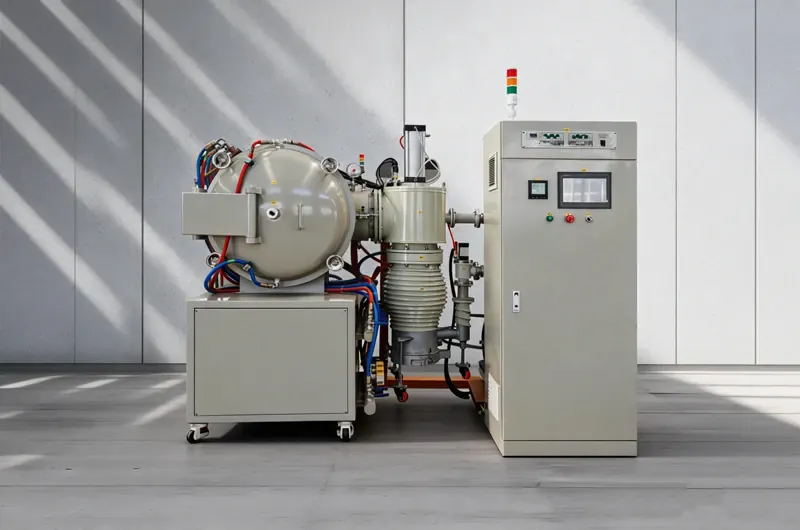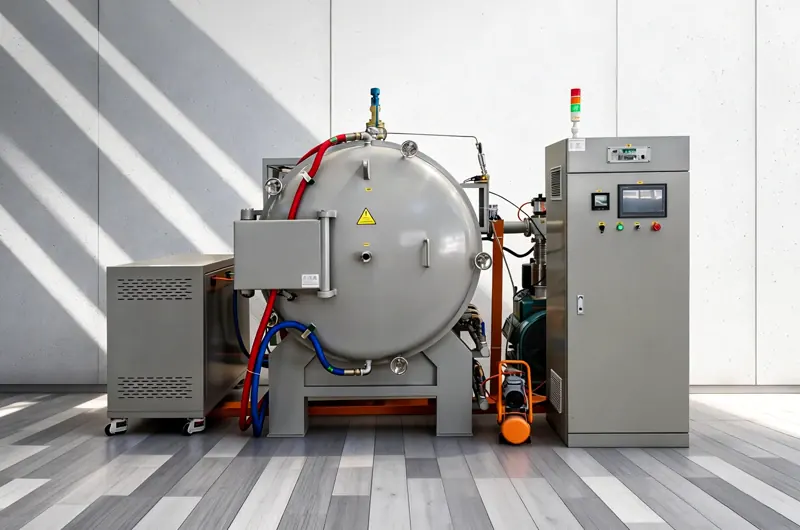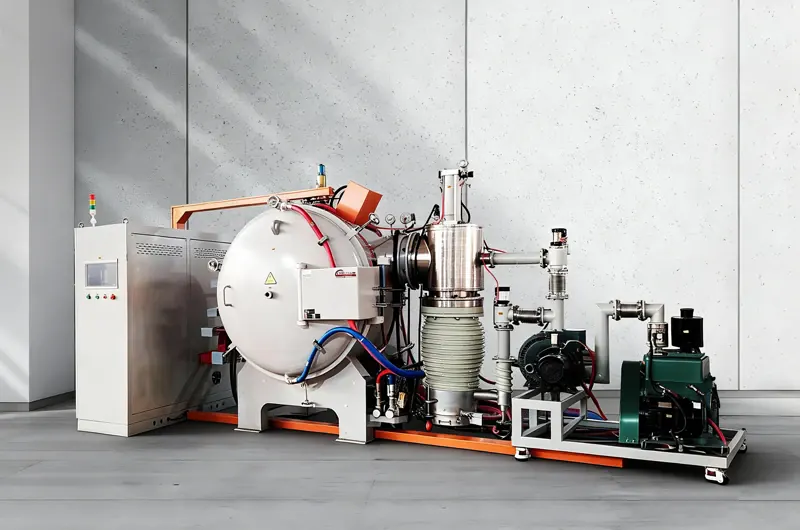
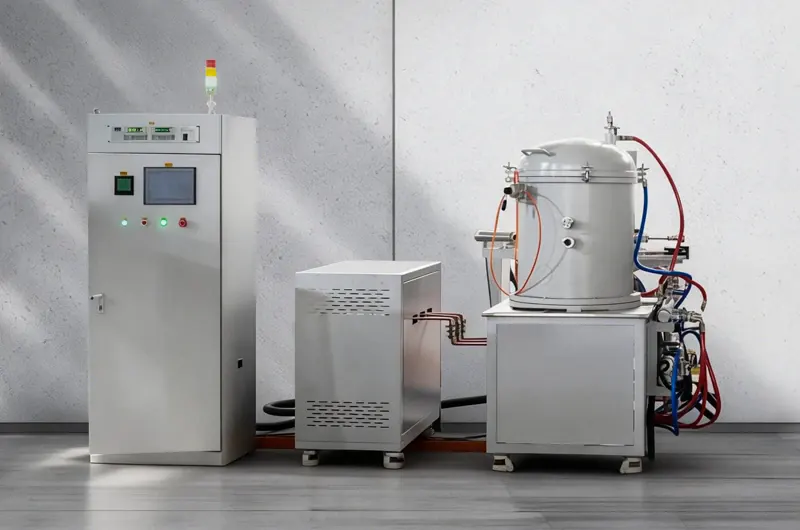
A vacuum graphite carbon tube furnace is a compact high-temperature unit in which the heating element and the hot zone are the same component. A graphite tube, clamped at both ends and fed with low-voltage, high-current power, heats itself and everything inside it. It reaches 2400 °C without a separate element to replace, and it is the most efficient way to heat slender parts and small samples.
Why the tube shape decides everything
Almost every other furnace type is built by putting an element around a chamber. A tube furnace works in reverse, because the chamber wall is the element. Every other property of the machine follows from that single decision.
Low thermal mass comes first. A 100 mm bore graphite tube reaches 2000 °C in 30 to 60 minutes, where a felt-insulated box hot zone of similar volume takes two hours or more. Geometry comes second. The tube surrounds the load evenly on all sides, so there is no element-to-load view factor to manage, and uniformity across the central section typically holds within ± 5 °C. Cost comes third, and it is the reason tube furnaces stay in workshops long after a bigger unit would have paid for itself: the entire hot zone is one part, so a rebuild means ordering a tube rather than reassembling an insulation stack.
The trade-off is geometric and it cannot be designed around. The work has to fit through the bore and it has to enter from one end. No amount of fixturing changes that, which makes a vacuum graphite carbon tube furnace a specialist rather than a general-purpose machine.
What goes inside the tube
| Material | Typical parts | Temperature | Atmosphere |
|---|---|---|---|
| Cemented carbide | Indexable inserts, small drills, wear buttons | 1380 – 1480 °C | Vacuum, then Ar backfill |
| Refractory metals | W, Mo, Ta and Nb slugs and rods | 2000 – 2400 °C | Vacuum |
| Oxide ceramics | Al₂O₃, ZrO₂, YAG coupons | 1500 – 1750 °C | Vacuum / Ar |
| Non-oxide ceramics | SiC, Si₃N₄, B₄C coupons | 1700 – 2100 °C | Vacuum / Ar |
| Carbon materials | Isostatic graphite samples, C/C coupons | 2000 – 2400 °C | Vacuum / Ar |
| Magnetic alloys | SmCo, Alnico, FeSiAl small parts | 1050 – 1250 °C | Vacuum |
| Glass and quartz | Sealing, drawing and annealing of small tube | 900 – 1300 °C | Vacuum / N₂ |
Two rows carry most of the weight. Refractory metals sit in a band where a molybdenum chamber has already reached its ceiling and a box graphite furnace is only getting started, so the tube furnace covers a temperature window that nothing else covers cheaply. Everything below that is small work, and that is not a coincidence. Tube furnaces are the standard development tool in powder metallurgy and ceramic research, and they stay in production for small parts made in modest quantities.
Specifications
| Parameter | Unit | Range |
|---|---|---|
| Maximum temperature | °C | 2400 |
| Continuous working temperature | °C | 1600 – 2200 |
| Tube bore | mm | 60 – 200 |
| Heated length | mm | 300 – 1200 |
| Charge weight | kg | 0.5 – 15 |
| Ultimate vacuum | Pa | 1 × 10⁻³, or 1 × 10⁻⁴ with a diffusion pump |
| Leak-up rate | Pa/h | 0.67 or better |
| Temperature uniformity | ± °C | ± 5 across the central 60 % of the heated length |
| Heating element | — | The graphite tube itself, direct resistance heating |
| Power supply | — | Low-voltage, high-current transformer, typically 15 – 60 kVA |
| Temperature sensing | — | Type C thermocouple to 1800 °C, infrared pyrometer above |
| Atmosphere | — | Vacuum, Ar, N₂ |
| Cooling | — | Water-cooled end flanges; the tube cools by radiation |
Those numbers describe a standard horizontal build of the vacuum graphite carbon tube furnace. Sizes are quoted by bore and heated length because those two dimensions decide what the machine can ever do. A wider bore costs more than a longer one, since the tube wall thickens with diameter and so does the current needed to push the same power through it.
How it compares with the box graphite furnace
| Graphite tube | Graphite box | Vertical bottom-load | |
|---|---|---|---|
| Part geometry it suits | Long and slender, under 200 mm across | Flat or bulky, any shape | Tall and heavy, up to a few hundred kg |
| Typical charge | 0.5 – 15 kg | 50 – 500 kg | 100 – 1500 kg |
| Heat-up to working temperature | 30 – 60 min | 1.5 – 3 h | 3 – 6 h |
| How the load enters | Pushed through one end | Front door, on trays | Raised from below on a hearth |
| Temperature ceiling | 2400 °C | 2200 °C, 2800 °C in special builds | 2800 °C |
| Carbon in the chamber | Yes | Yes | No |
| Buy it when | Slender parts, samples, development work | Production volume in a range of shapes | Large refractory metal parts |
The box furnace wins on volume and loses on speed. Compared with a 45-minute cycle on a vacuum graphite carbon tube furnace, a batch that takes three hours to come up to temperature and another six to cool decides how many experiments you can run in a week, and for small parts that usually decides the purchase.
What fails, and why
Graphite tubes do not wear out, they break, and the break almost never happens at the maximum temperature. Four causes account for nearly all of it.
Thermal shock is the first. Graphite tolerates fast heating in the middle of the range and far less of it around 1000 °C, where the tube is still cool enough to be brittle and the current density is already high. A ramp that looks conservative on paper can still crack a tube if it is repeated every day.
The flange is the second, and the most common. Both ends of the tube are held in water-cooled clamps, and that joint is the steepest temperature gradient in the furnace. Every cycle works that area. Cracks start there, run along the tube axis, and show up as a vacuum that will no longer hold.
Handling damage is the third. Graphite is soft enough that a boat or crucible dragged along the bore leaves a score, and a score is a crack starter. Most tubes that fail early failed because of how the load went in, not because of how the furnace ran.
Oxidation is the fourth, and it is the one that takes months. Any oxygen or water vapour present above roughly 1000 °C attacks graphite slowly. The tube wall thins from the inside, the resistance creeps up, and the same power setting starts producing a lower temperature. A rising power draw for an unchanged profile is the signal to measure the wall.
Replacement intervals reflect all four causes. The tube in a vacuum graphite carbon tube furnace used a few times a week lasts 12 to 24 months; the same tube in a furnace running daily lasts 6 to 12. Two habits matter more than anything else when a new tube goes in. Torque the clamps to the figure the supplier gives and no more, because graphite fails in compression without warning, and run a slow first heat under vacuum to drive off the moisture the tube absorbed in storage.
When a tube furnace is the wrong purchase
Four situations where the geometry or the material rules this machine out.
Anything larger than the bore is the obvious one, and there is no workaround. A part that does not fit has to go to a vacuum graphite sintering furnace with a box hot zone, which will also give you ten times the charge weight for a fraction of the price per kilogram.
Carbon-sensitive materials are the second. Titanium, zirconium, tantalum, transparent ceramics and medical implants all suffer from carbon pickup, and the graphite tube is a large carbon surface sitting at temperature right next to the load. Those parts belong in a molybdenum strip vacuum sintering furnace, which gives up 800 °C of ceiling to remove every trace of carbon from the chamber.
Residual porosity is the third. A tube furnace sinters; it does not densify under pressure. If the specification requires closed porosity gone under 1 to 10 MPa of argon, the machine you need is a vacuum Sinter-HIP furnace, and no process tweak on a tube furnace will get you there.
The fourth is the opposite end of the temperature range. For small samples below about 1400 °C, where a shallow vacuum is acceptable and turnaround matters more than atmosphere purity, a ceramic fiber vacuum sintering furnace does the same job for less money and in a smaller footprint. Above 2500 °C on a large part, the tube runs out of diameter long before it runs out of temperature, and a vacuum tungsten wire sintering furnace takes over.
Questions buyers ask
Is a carbon tube furnace a production machine or a laboratory tool?
Both, at different volumes. A vacuum graphite carbon tube furnace is the standard development tool in powder metallurgy and ceramics, and it stays in production for small parts where a few kilograms per cycle is the right batch size. It stops being economical when the same part needs tens of kilograms a day.
How long does a graphite tube last?
Twelve to twenty-four months in laboratory use and six to twelve months in daily production. The interval is set by thermal cycling and by vacuum discipline far more than by peak temperature.
Why did my tube crack at the flange?
Because that is where the temperature gradient is steepest and where the clamp concentrates stress. Too much clamp torque, a tube that is not sitting coaxially, or a cool-down that is faster than the tube can follow will all start a crack there.
Can the furnace run hydrogen?
It can, with the right safety package, since graphite is unaffected by hydrogen. Most tube furnaces ship set up for vacuum and inert gas, so hydrogen has to be specified up front along with the gas train, the burn-off and the interlocks.
Is there a difference between a carbon tube and a graphite tube?
In everyday use the terms are interchangeable. Strictly, graphite tube means machined or pressed graphite, and carbon tube also covers carbon fibre composite tube. The composite version resists thermal shock better and costs considerably more, which makes it worth asking about if your cycle involves fast cooling.
Next step
Send us the part you want to run, the largest dimension and the target temperature. If it fits a tube, we will size the bore, the heated length and the pump set of a vacuum graphite carbon tube furnace around your cycle. If the geometry or the material points somewhere else in the vacuum sintering furnace range, we will say so before you place an order.