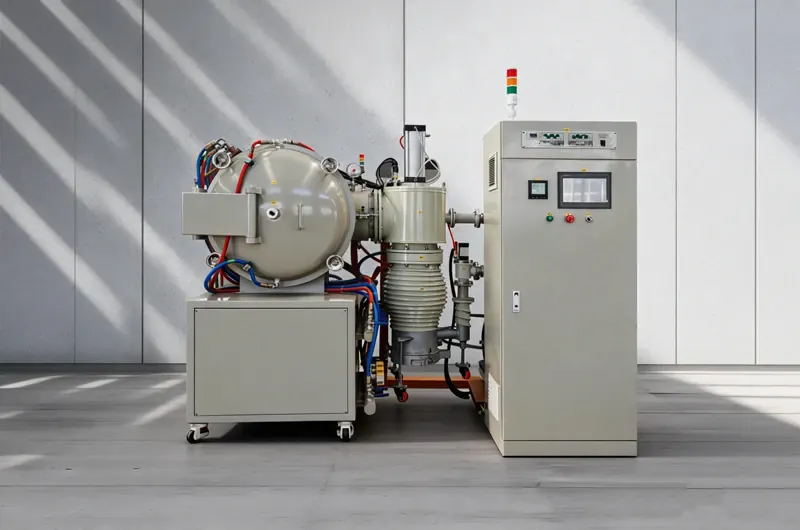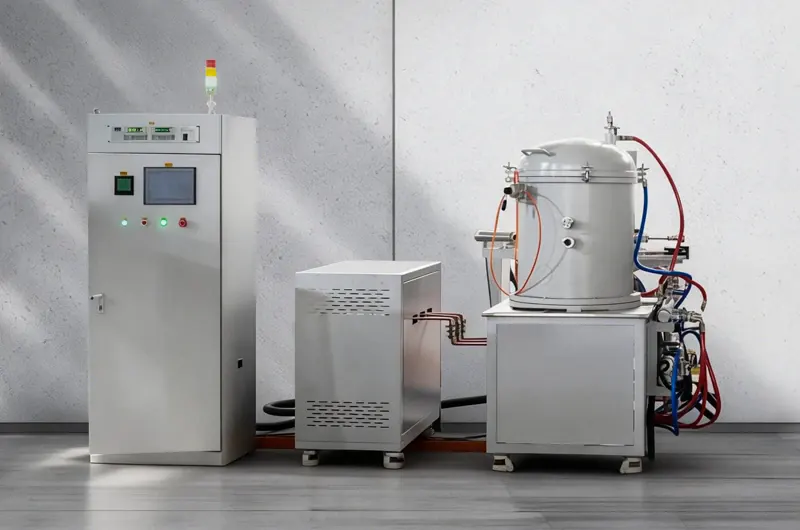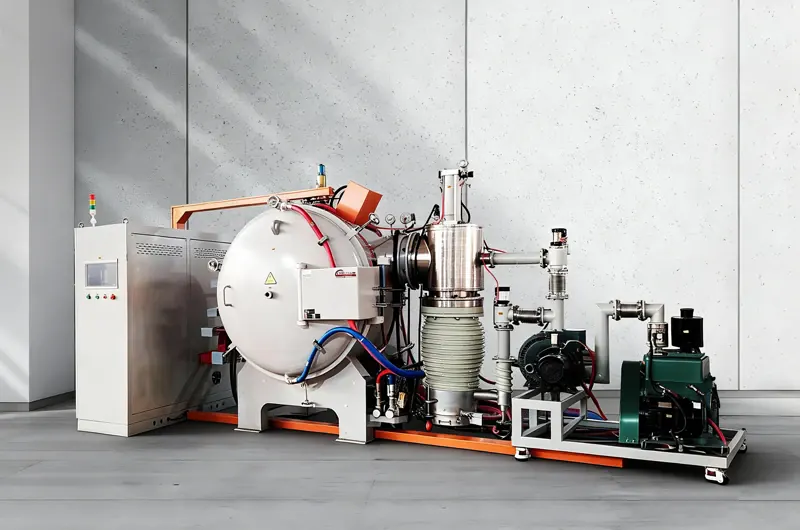
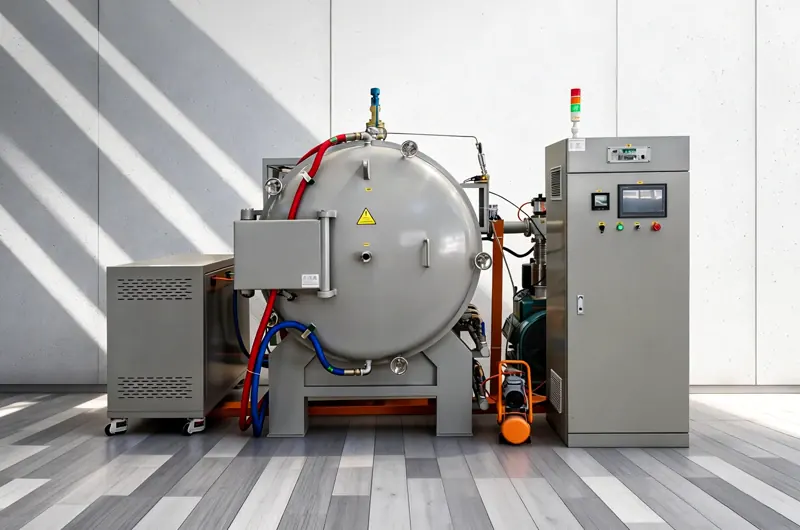
A ceramic fiber vacuum sintering furnace is a compact batch furnace for laboratory and pilot-line work up to 1400 °C. The hot zone is a low-mass alumina-silicate fiber wall, so the furnace reaches setpoint in well under an hour, introduces no carbon into the sample, and can be emptied and reloaded inside a single shift.
Two inputs define the application: a batch measured in kilograms rather than hundreds of kilograms, and a requirement for a clean surface with a fast turnaround. A ceramic fiber vacuum sintering furnace fits where both conditions hold.
Where a fiber hot zone earns its place
Three groups of buyers specify this design, and none of them runs production tonnage.
Ceramics and powder-metallurgy laboratories
A ceramics or powder-metallurgy laboratory fires 10 to 20 small coupons per run — discs of 20 mm diameter and 5 mm thickness are typical — three to five times a week. Those laboratories came to this design after an earlier carbon hot zone left a grey surface layer on the samples. The layer ruined optical and electrical measurements, and polishing removed it without restoring the oxygen stoichiometry underneath.
Pilot lines qualifying a binder
A pilot line proves the shrinkage curve before a binder formulation reaches production. Two hundred to five hundred grams of test bars per cycle is the typical batch, and a ceramic fiber vacuum sintering furnace lets the laboratory change the debinding schedule without touching the schedule of the production furnace.
Phosphor, laser crystal and sealing work
Phosphor, laser-crystal pre-sinter and glass-to-metal sealing are three processes where a reducing carbon atmosphere shifts the emission spectrum or darkens the part.
General annealing and degassing of small metal or ceramic parts sits alongside it. Vacuum is genuinely needed for those parts, but the footprint and outgassing load of a large production hot zone cannot be justified.
What the fiber hot zone actually does
Alumina-silicate fiber works as both insulation and structural hot zone wall. Standard-grade blanket is rated for continuous use around 1260 °C, and high-purity or polycrystalline mullite grades push that to roughly 1400 °C, which is the practical ceiling of this design.
Thermal mass is the first property that matters. Fiber blanket carries roughly a tenth of the mass of a dense refractory wall, so the chamber reaches setpoint in 40 to 60 minutes and gives the heat back just as quickly on the way down.
Chemistry is the second. Fiber is an oxide, so it will not carburise a part, will not getter oxygen from a ceramic, and will not introduce carbon into a carbide-sensitive alloy.
The trade-off is mechanical: fiber is soft and it shrinks. Above about 1000 °C the amorphous fiber crystallises into mullite and cristobalite, which makes the wall brittle and pulls it away from its original thickness. After a few hundred hours at 1300 – 1400 °C, gaps open at the panel joints, and the top of the load stops matching the bottom.
Heating elements in this design are normally molybdenum disilicide (MoSi₂) rods. MoSi₂ holds an element temperature of 1700 – 1800 °C in air, but inside a vacuum chamber the usable furnace temperature drops to roughly 1400 – 1500 °C, because the protective silica skin behaves differently once oxygen is scarce and silicon leaves the surface. Above that ceiling both the element chemistry and the hot zone material have to change, and the result is a different furnace rather than an option on this one.
Two thermocouples are worth specifying rather than one. The control couple sits behind the hot zone where the load cannot shade it, and a second couple trailing beside the parts shows how far the furnace is running ahead of the work. The gap between the two readings accounts for most "the profile was correct but the parts came out wrong" complaints.
A batch from cold to cool
A 1400 °C cycle moves through four stages, and each stage carries its own failure mode.
Loading the hot zone
Loading is where parts are lost. Trays go in with a clear line of sight to the elements. Stacking samples in a tall pile so the middle ones only see each other creates a 50 – 80 °C shadow: the middle of the pile comes out under-sintered while the outer ones are already over-fired. Space the load, keep it low, and accept two batches instead of one.
Pump-down
A two-stage rotary pump plus Roots blower reaches 10 Pa in about ten minutes on a cold, dry chamber. The last decade of pressure is slow the first time, because fiber holds adsorbed moisture that leaves between 200 and 500 °C rather than at room temperature. A new or freshly relined furnace needs an empty bake-out cycle to 900 – 1000 °C under vacuum before anything valuable goes inside, otherwise the pressure bump lands in the middle of the sintering hold.
Heating
A small load heats at 5 to 10 °C per minute — fast enough to be useful, slow enough to keep the control thermocouple ahead of the load. Thick sections set the real limit: a 20 mm coupon trails the chamber by 30 – 50 °C, so the hold starts when the part reaches temperature, not when the thermocouple does.
Cooling and backfill
Stopping the cycle at around 600 °C and backfilling with nitrogen or argon to a slight positive pressure pulls heat out of the load several times faster than radiation into vacuum. A 1400 °C cycle with a 1 kg load typically lands between six and nine hours door to door.
Parameters
| Parameter | Unit | Range |
|---|---|---|
| Maximum temperature | °C | 1200 / 1400 depending on fiber grade |
| Continuous working temperature | °C | 1100 – 1300 |
| Useful hot zone | mm | 150 × 150 × 200 up to 400 × 400 × 500 |
| Load capacity | kg | 1 – 5 |
| Ultimate vacuum | Pa | 1 × 10⁻² after bake-out |
| Working vacuum | Pa | 1 – 100, or partial pressure Ar / N₂ |
| Heating rate | °C/min | 5 – 10 |
| Temperature uniformity | ± °C | ± 5 at 1000 °C in an empty hot zone |
| Heating elements | — | MoSi₂ rods, 1700 – 1800 °C element rating |
| Thermocouple | — | Type K to 1100 °C, type N or S above |
| Atmosphere | — | Vacuum, Ar, N₂ |
| Control | — | Programmable ramp / soak, over-temperature cut-out |
Consumables and what actually wears out
| Item | Typical life | What kills it early |
|---|---|---|
| MoSi₂ heating elements | 12 – 24 months | Idling in the 400 – 700 °C band in air, humid storage, hydrogen service |
| Fiber hot zone | 18 – 36 months | Frequent 1400 °C holds — crystallisation and shrinkage accelerate above 1300 °C |
| Door O-ring | 12 – 18 months | Heat soak from running the shell hot, and grit on the sealing face |
| Type K thermocouple | 6 – 12 months above 1100 °C | Chromium evaporation in vacuum — the reading drifts low and quietly |
| Vacuum pump oil | 6 – 12 months | Water vapour and binder residue; halve the interval where organics are processed |
MoSi₂ suffers a low-temperature oxidation collapse known as pesting, worst between 400 and 700 °C when moisture is present. A furnace that is run hard survives; a furnace brought to 500 °C, switched off and left in a damp workshop for three weeks loses its elements. Running it to full temperature once a month, even when idle, prevents that.
Where the window ends
Above 1400 °C, fiber is out. For 1600 °C work with no carbon in the chamber, the route up is a molybdenum strip vacuum sintering furnace, which replaces the fiber wall with layered molybdenum radiation shields. Where carbon is acceptable and the load is heavier, a vacuum graphite sintering furnace covers 1800 – 2200 °C in a much larger chamber.
Below about 10⁻² Pa, fiber becomes the limiting factor, because its surface area keeps releasing moisture regardless of the pump set. A ceramic fiber vacuum sintering furnace is a 10⁻² Pa design, and deeper vacuum needs an all-metal hot zone.
Reactive metals are a hard no. Titanium, zirconium and their alloys reduce the fiber at temperature and pick up silicon and oxygen from it. Those materials belong in a molybdenum strip chamber or a vacuum tungsten wire sintering furnace.
Hydrogen at temperature is also a hard no with MoSi₂ elements, because hydrogen reduces the protective silica layer and the rods fail from the surface inward. Argon and nitrogen are fine, and a process that genuinely needs hydrogen needs a different hot zone chemistry rather than a different gas setting.
Finally, a load that grows past roughly 5 kg per batch, or a cycle that runs every day, ends the case for this design. Fiber replacement intervals shorten, and the hour saved on heat-up is worth less than the throughput of a larger chamber.
Where carbon is acceptable and the parts are slender, a graphite carbon tube furnace covers 2400 °C from a smaller footprint. Where carbon has to stay out of the chamber, a molybdenum strip vacuum sintering furnace covers the same load at a 1600 °C ceiling, and where the parts need pressure-assisted densification after sintering, a vacuum Sinter-HIP furnace is the design that follows.
Matching the process to this design
| Process situation | Fits | What the answer is |
|---|---|---|
| Batch under 5 kg, target 1100 – 1300 °C, clean surface required | Yes | Standard fiber hot zone with MoSi₂ elements |
| 1600 °C with no carbon in the chamber | No | Layered molybdenum radiation shields |
| Load of 20 kg or more, three shifts a day | No | Larger hot zone in a heavier-duty design |
| Ultimate vacuum below 10⁻² Pa | No | All-metal hot zone |
| Titanium, zirconium, or hydrogen at temperature | No | Different hot zone chemistry |
| Parts needing pressure-assisted densification | No | Sinter-HIP after sintering |
Buying a ceramic fiber vacuum sintering furnace "in case higher temperature is needed later" is a mistake this design cannot recover from: the fiber wall and the element set both stop at the ceiling listed above.
Questions buyers ask
Can a fiber furnace really reach 1400 °C in vacuum?
Yes, with high-purity or polycrystalline mullite fiber and a matched MoSi₂ element set. Expect the fiber itself to age faster above 1300 °C, so treat 1300 °C as the working number and 1400 °C as the occasional ceiling.
Is the hot zone genuinely carbon-free?
The furnace is; the process may not be. Carbon setters and carbon foil put carbon straight back into the chamber. Alumina or zirconia furniture is what keeps a clean result clean.
Why is pump-down so slow on a new furnace?
Adsorbed moisture in the fiber. Run an empty cycle to 900 – 1000 °C under vacuum, hold for an hour, cool and repeat once, and the pump-down time settles.
Why did the MoSi₂ elements fail after only a year?
Almost always pesting between 400 and 700 °C with moisture present. Keep the furnace dry, avoid parking it in that band, and run it to full temperature periodically.
Can hydrogen be used?
Not with MoSi₂ elements. Hydrogen attacks the protective silica layer and the rods degrade. Argon or nitrogen are the options, or a hot zone material that tolerates hydrogen.
How large a load fits?
One to five kilograms across the hot zone sizes this design covers, spread out rather than stacked. A heavier batch needs a larger chamber in a heavier-duty design.
Is a diffusion pump needed?
Not to reach 10⁻² Pa — a two-stage rotary vane pump with a Roots blower is enough. Going deeper needs a high-vacuum pump, and at that point the fiber is the limiting factor rather than the pumping system.
What to send with an enquiry
Three inputs size a ceramic fiber vacuum sintering furnace: the material to be processed, the largest part dimensions and the target temperature. Where the work fits inside the fiber window, the hot zone and the pump set are quoted around the load. Where it does not, the vacuum sintering furnace range carries the design that will.