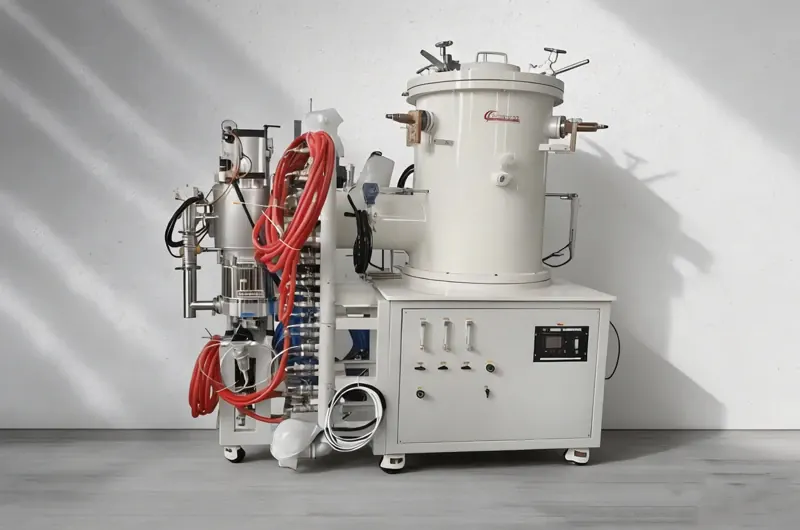
A vacuum sinter-HIP furnace sinters a powder compact under vacuum until its pores close, then backfills the same hot chamber with argon at 5 to 6 MPa and holds that pressure while the cobalt binder is still liquid. Pressure applied at that moment closes the last 2 to 4 percent of porosity, and the load never leaves the hot zone to do it.
Where pressure replaces a second furnace
Vacuum sintering stops at 95 to 98 percent of theoretical density. The remainder sits as closed pores at grain boundaries, and extra hold time does not remove it, because surface energy alone cannot overcome the gas pressure trapped inside a pore that has already rounded.
A standalone hot isostatic press closes those pores at 100 to 200 MPa and about 1350 °C. The part cools first, then returns to temperature in a second vessel, and every pass through the liquid-phase window coarsens the WC skeleton. On a fine-grain grade that second pass costs hardness which no later step recovers.
The vacuum sinter-HIP furnace keeps both stages in one chamber, so the load holds above 1000 °C from the sinter hold into the pressure hold. Argon at 5 to 6 MPa then meets pores that are still small, a binder that is still liquid and grain boundaries that are still mobile, and those three conditions are why one twentieth of HIP pressure does the same work.
Pressure assistance also shortens the dissolution-precipitation cycle, so peak temperature falls 30 to 50 °C against the same grade sintered in vacuum. The lower peak and the shorter hold together protect grain size, and grain size sets hardness at a given cobalt content.
What happens inside one cycle
A production cycle runs through four stages, and each stage carries a limit the operator can measure at the panel.
Dewaxing and the first ramp
Pressed compacts arrive with 6 to 9 percent paraffin or PEG binder, and the dewaxing stage drives it off under vacuum or a hydrogen partial pressure before the load passes 600 °C. A condenser returns at least 98 percent of the wax weight, which keeps the pump set and the insulation from loading up with vapour.
Ramp rate follows the load, not the furnace rating: 8 °C/min on an empty chamber and no more than 5 °C/min fully loaded, with soaks at 600, 1000 and 1200 °C to flatten the surface-to-core gradient through a thick section.
Vacuum sintering to closed porosity
WC-Co grades hold between 1380 and 1480 °C, with the setpoint fixed by cobalt content and grain size target. Hold time runs 30 to 90 minutes and follows the largest section thickness in the load rather than its total weight.
Chamber pressure stays at 1 Pa or below through this stage. A chamber at 1 Pa pulls residual oxygen and water vapour out of the compact, and this stage decides whether the pores close before the gas arrives.
Partial pressure, then overpressure
Argon enters at 1 to 50 mbar of partial pressure as the load approaches peak, which suppresses cobalt evaporation and evens out the temperature field across the working zone. Full pressure follows at the point where the liquid binder reaches its maximum volume fraction and before grain coarsening begins.
Nitrogen is not the gas for this stage. Argon stays chemically inactive at 1500 °C, while nitrogen reacts with the titanium hard phase in cermets and shifts the binder composition.
Chamber pressure climbs to 5 to 6 MPa in 20 minutes or less, provided the site supply holds 130 bar at the inlet. The hold under pressure runs 20 to 60 minutes, and the load stays within 10 °C of the sinter setpoint throughout it.
Pressure cooling
Gas circulated through an internal heat exchanger takes the load from 1450 to 100 °C in 4 hours on a 300 kg charge, and 6 to 7 hours on a 400 × 400 × 1200 mm chamber. Pressure is held through the first part of the drop and released below 1000 °C, which keeps pores closed while the binder is still soft.
Cold-to-cold cycle time lands between 10 and 16 hours. The cooling stage, not the heating stage, sets how many cycles a furnace returns in a working day.
The figures that belong in the purchase specification
Table 1 lists the values a quotation for a vacuum sinter-HIP furnace has to state in writing, because each one drives vessel design, pump set or power supply.
| Parameter | Value to specify |
|---|---|
| Design temperature | 1600 °C |
| Maximum working temperature | 1550 °C |
| Maximum working pressure | 5.8 MPa (58 bar) |
| Ultimate vacuum, cold and empty | 1 Pa |
| Leak-up rate | ≤ 3 Pa/h over 24 hours |
| Ramp rate, empty / fully loaded | 8 / 5 °C per minute |
| Pressurising time | ≤ 20 minutes at 130 bar inlet |
| Cooling, 1450 to 100 °C | ≤ 4 hours on a 300 kg charge |
| Temperature uniformity | ± 7 °C across the working zone |
| Useful zone | 300 × 300 × 600 to 400 × 400 × 1200 mm |
| Charge weight | 50 to 300 kg |
| Connected power | 150 to 320 kVA |
| Thermocouples | WRe5-26 duplex, three control zones |
A leak-up rate of 3 Pa/h or lower is measured on an empty, clean, cold chamber over 24 hours once the ultimate vacuum has been reached. The same number read on a warm chamber means nothing, and a rate above 5 Pa/h usually points at an electrode seal rather than at the pump.
Uniformity is verified with YG8 or YC40 test pieces rather than with a bare thermocouple. Magnetic saturation within ±0.25 percent and coercivity within ±0.3 kA/m across the load show that gas and heat reached every corner of the charge.
Which work earns the pressure
On a vacuum sinter-HIP furnace, pressure adds a vessel, a compressor, gas handling and a heavier hot zone, so the parts have to need the last 2 percent of density. Three families of work usually do.
Cutting tools in fine and medium grain
Inserts and solid round tools in the 6 to 12 percent cobalt range fail at the cutting edge long before the bulk wears out, and edge chipping tracks residual porosity more closely than it tracks hardness. A density move from 97 to 99.5 percent shows up as transverse rupture strength rather than as a different grade label.
Wear parts with thick sections
Roll rings, die inserts and seal rings above 20 mm section close their pores last at the centre, because the vapour path out of the core is longest there. Pressure applied while the core is still liquid reaches the centre; a second HIP pass reaches it only after the part has cooled and reheated.
Cermets with a titanium hard phase
TiCN-based cermets sinter inside a narrow liquid-phase window, and the pressure stage widens the tolerance on that window. A grade that would need a tight ramp profile in vacuum tolerates a wider one when 5 MPa arrives at the right moment.
Two families rarely need the pressure stage. Stainless steel and copper-based MIM parts accept around a percent of residual porosity in their own specifications, and a pressure vessel bought to chase that percent returns nothing.
| Work | Typical section | Does pressure pay | What decides it |
|---|---|---|---|
| Carbide inserts and solid round tools | 3 to 20 mm | Yes | Edge chipping and transverse rupture strength |
| Ultra-fine and low-cobalt grades | Under 10 mm | Yes | Grain size must survive densification |
| Roll rings, die inserts, seal rings | 20 to 80 mm | Yes | Closed porosity at the core |
| TiCN-based cermets | 5 to 30 mm | Yes | Narrow liquid-phase window |
| Stainless and copper MIM parts | Under 10 mm | Usually no | Specification already allows 1 percent porosity |
| Silicon nitride and boron carbide parts | Any | No, temperature too low | Needs 1700 to 2200 °C |
Silicon nitride and boron carbide need a peak above 1700 °C, which sits 150 °C beyond the working limit of this chamber.
Where the pressure stage goes wrong
The setpoint sags when argon enters
A vacuum has almost no convective path between the load and the wall, and argon at 5 MPa has a strong one. The power needed to hold 1450 °C can jump 30 to 60 percent within a minute of the valve opening, and a furnace without feed-forward compensation keyed to valve position drops 20 to 50 °C through the whole pressure hold.
A density map showing the load interior lighter than its edge is the tell. The pressure stage ran cold, and the last percent of density never closed.
Pores that were still connected
Argon driven into an open pore network gets sealed in as the part densifies around it, and the cross section then shows round gas bubbles that were not there before backfill. The fault belongs to the sintering stage rather than to the pressure stage: the load had not closed when the gas arrived, usually because the sinter hold was short or the ramp across the closure temperature was fast.
Trays that block shrinkage
A carbide compact shrinks 17 to 20 percent linearly, and a tray surface with high friction holds the bottom face back while the rest of the part contracts. The result is a bowed insert or a crack that appears only after grinding opens it.
Flat, well-supported tray plates and a thin bedding layer of coarse powder let the part slide as it shrinks. Stacked parts need the same allowance between layers, and a stack loaded too tall shows the effect at the bottom third.
Instruments that drift
WRe5-26 thermocouples drift at 1500 °C, and a 20 °C error at the setpoint moves hardness by more than a full HRA point on a fine-grain grade. A duplex pair with a scheduled calibration every 6 to 12 months is the cheap half of the fix.
The vacuum gauge and the leak-up test are the other half. A gauge that reads 1 Pa when the chamber is at 5 Pa lets the operator start the pressure stage on a load that never closed.
What 5.8 megapascals cannot do
A vacuum sinter-HIP furnace is not a hot isostatic press. The 5.8 MPa ceiling closes porosity in a part that is already 97 percent dense; a true HIP at 100 to 200 MPa densifies castings, bonds dissimilar metals and repairs near-net-shape defects. Casting work needs that class of vessel.
Geometry is set by the press or the injection mould, and no amount of isostatic gas changes it. Hot pressing is the route that deforms the part under load, and that route is covered by the vacuum hot press sintering furnace.
Batch weight decides the economics. A vessel, a compressor and gas handling are fixed costs that a 10 kg batch carries alone, so development work under about 20 kg per cycle usually costs less in a vacuum debinding and sintering furnace or a molybdenum strip furnace.
Peak temperature decides the material list. Reaching 1700 °C or more for silicon nitride, boron carbide or transparent ceramics takes a different heat source, and the spark plasma sintering furnace covers that range at small batch size.
| Route | Pressure | Peak temperature | What it does to the part |
|---|---|---|---|
| One-chamber sintering plus pressure | 5 to 6 MPa argon | 1550 °C | Closes porosity in a part already sintered to 97 percent |
| Vacuum sintering alone | None | 1550 °C | Leaves 2 to 5 percent closed porosity |
| Standalone HIP | 100 to 200 MPa argon | 1350 °C | Densifies castings and repairs defects in a cold part |
| Hot pressing | Uniaxial, 10 to 40 MPa | 2200 °C | Densifies and changes geometry at the same time |
| Spark plasma sintering | Uniaxial, 30 to 100 MPa | 2200 °C | Densifies fine-grain ceramics in minutes |
Consumables and the interval between rebuilds
Heating elements and the insulation liner age on a schedule that the power log records before the operator notices it. A draw 10 to 15 percent above the baseline logged when the furnace was new, at the same setpoint and the same load, marks the start of element ageing.
A furnace running daily typically needs heating elements at 6 to 12 months and a full insulation rebuild at 12 to 24 months. A rigid insulation liner cracks rather than fails, and a cracked liner shows up first as a slower ramp and a colder corner of the working zone.
Argon consumption belongs in the running cost before the order. A 0.5 m³ chamber at 5 MPa takes about 40 kg of gas per fill, and a furnace running two cycles a day spends close to two tonnes a month unless a recovery system returns 85 to 95 percent of it.
Questions buyers ask
How is this different from a vacuum sintering furnace?
A vacuum sintering furnace stops when the pores close and the load cools from there. A vacuum sinter-HIP furnace adds a pressure vessel, a gas supply and a feed-forward temperature loop, and applies argon before the load drops out of the liquid-phase range.
Can it replace a debinding furnace?
The pressure vessel handles dewaxing for a pressed compact carrying 6 to 9 percent binder, which covers most carbide inserts and round tools. A part arriving with 12 percent or more binder, or a multi-component injection moulded shape, needs a dedicated debinding furnace first, because the vapour load exceeds what the vessel is cleaned for.
How much density does the pressure stage add?
Typically from 96 to 98 percent up to above 99.5 percent of theoretical. The last band governs transverse rupture strength, edge chipping under interrupted cutting and fatigue life, which is why the stage exists.
Why does the temperature fall when the gas goes in?
Argon at 5 MPa strips heat off the load by convection, and the panel has to add 30 to 60 percent more power within a minute of the valve opening. A feed-forward loop keyed to valve position supplies that power. A loop that waits for the thermocouple to react leaves the load 20 to 50 °C low for the whole hold.
Is argon recovery worth specifying?
On a furnace running production cycles, yes. Recovery returns 85 to 95 percent of the gas, and on a chamber that takes roughly 40 kg per fill the payback is measured in months.
Before the quotation
Six inputs fix the size of a vacuum sinter-HIP furnace and the pressure range that goes with it: the grade and cobalt content, the largest section thickness, the batch weight per cycle, the density or transverse rupture strength the part has to reach, the argon supply pressure available on site, and whether the load arrives already dewaxed.
A quotation issued without the last two tends to come back with a smaller compressor and a dewaxing stage nobody priced. Where the work needs a chamber rather than a pressure vessel, the vacuum sintering furnace range covers the alternative.