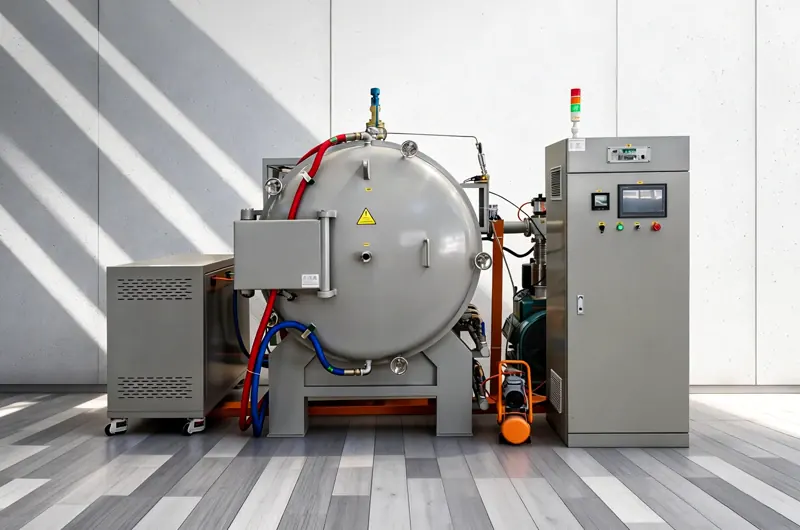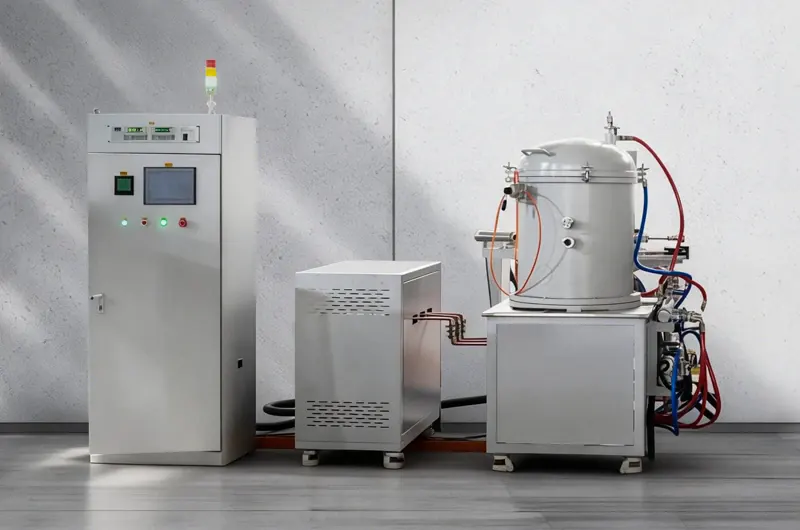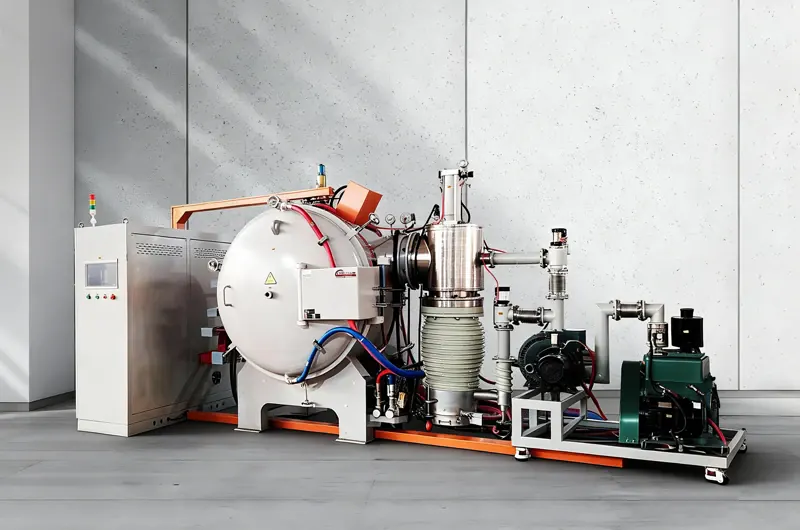
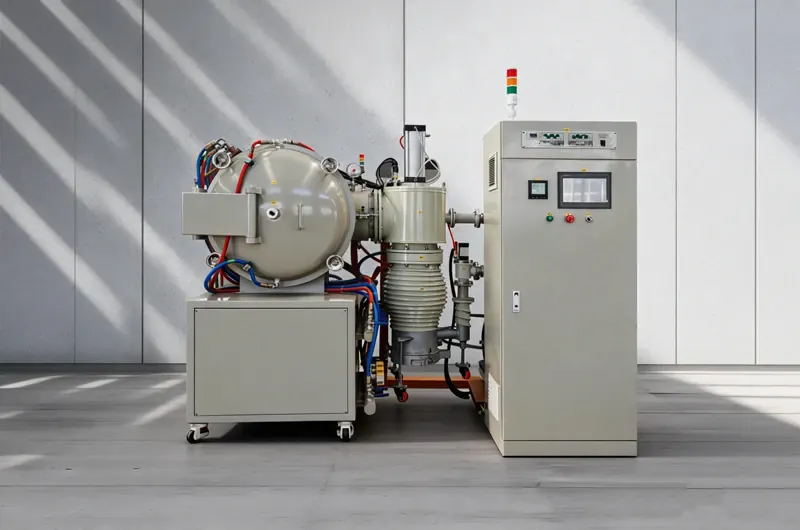
A molybdenum strip chamber vacuum sintering furnace is a batch furnace rated to 1600 °C, with molybdenum strip as the heating element and layered molybdenum sheet as the insulation. Every surface that sees temperature is solid metal.
Two inputs decide whether this furnace suits a job at all: the temperature the cycle has to hold, and whether the finished part is inspected for oxygen, colour or transmission. A titanium implant or a transparent spinel window needs this chamber. An oxide insulator with no optical specification is better served elsewhere.
How the strip element is built
Molybdenum strip elements run at 99.95% purity and 0.1 to 2 mm thickness, formed into U, W or folded profiles. The strip is arranged as a cylinder around the load or as flat panels on two sides of the hot zone.
A strip presents a broad, flat radiating face. Surface power density is held at or below 2.5 W/cm² without the hot spots that form where a round element touches an insulator, and the 2.5 W/cm² ceiling is what separates a 5000-hour element from one that fails inside 1500 hours.
The element runs on low voltage and high current. A step-down transformer delivers roughly 10 V at 500 A, and installed power on the standard sizes falls between 25 and 55 kW.
Each heated zone carries its own control loop. A 900 mm chamber can run three zones at three setpoints and hold ±5 °C across the working volume.
How the shield stack holds heat
The insulation is a reflective stack, not a porous blanket. Two to ten layers of molybdenum foil, 0.05 to 0.5 mm thick, sit behind the elements, and two or three 310S or 304 stainless shields sit behind those.
Alumina spacers of 99% purity separate the layers and molybdenum nuts clamp them. Total stack thickness runs to 50 mm or more on the larger chambers.
Each layer reflects radiation back at the layer beneath it, so heat leaving the element meets a surface close to its own temperature rather than a cold wall. A light stack heats fast, and an empty chamber reaches 1300 °C in 120 to 150 minutes.
Solid sheet holds very little water on its surface. A chamber built this way pumps down within hours of a door opening and does not need a bake-out before every run.
The design costs installed power and consumables. Reflection loses more heat per square metre than bulk insulation, and the inner shield nearest the element is a wear item.
Three temperatures, and which one applies
A molybdenum strip chamber vacuum sintering furnace is sold as a 1600 °C furnace, held at 1300 to 1500 °C, and often quoted at 1300 °C working. All three numbers are correct, and each answers a different question.
| Figure | °C | What it governs |
|---|---|---|
| Design limit | 1600 | Element and shield sizing, short excursions |
| Long-term hold | 1300 – 1500 | Shield creep, element life, multi-hour production cycles |
| Quoted working temperature | 1300 | Sizing for daily cycles with long holds |
Pure molybdenum softens and creeps above about 1300 °C. Under its own weight the shield stack sags toward the load, the reflection geometry changes, and uniformity degrades before anything visibly fails.
Any hold longer than a few hours belongs in the 1300 to 1500 °C band. A 1600 °C setpoint is for a short excursion, and a four-hour hold at that level shortens shield life to months.
Sintering is the main duty
Sintering fills most of the hours on these chambers, across four families of work that differ in temperature, atmosphere and what counts as a good part.
Cemented carbide, pre-sintering
A pressed carbide blank goes in at 1200 to 1350 °C to gain handling strength while keeping its open porosity. The forming binder leaves the compact between 200 and 600 °C during the ramp, so the pump has to carry that load before the hold starts.
Acceptance rests on transverse rupture strength and on a shrinkage figure that matches the die design. A correctly pre-sintered blank can be machined like soft steel and still shrinks predictably in final sintering.
Cemented carbide, final sintering
Final sintering runs at 1380 to 1480 °C with a 45 to 90 minute hold in vacuum or partial-pressure argon, and this chamber covers it in small and medium batches and for work that must leave with a clean surface. The liquid cobalt phase moves at that temperature, so a ±5 °C spread across the load becomes a measurable difference in cobalt pool size and magnetic saturation between the top and bottom of the stack.
Parts sit in a single layer on zirconia or alumina setter plates at 5 mm spacing or more. A tall stack shades its own middle, and the middle leaves at a lower density than the faces.
Technical ceramics and cermets
Alumina, zirconia, silicon nitride, silicon carbide and aluminium nitride sinter between 1400 and 1600 °C. Transparent spinel and YAG use the top of that band for pre-sintering, and full transmission is reached in a later step at a higher temperature than this chamber offers.
A transparent ceramic that loses oxygen in deep vacuum turns grey, and polishing does not bring transmission back. A controlled backfill or a shallower vacuum during the hold prevents it.
Refractory metals, magnets and titanium
Tungsten, molybdenum, tantalum and niobium parts are sintered and purified between 1500 and 1600 °C. NdFeB and SmCo magnets sinter near 1000 to 1100 °C and temper below that.
Titanium and Ti-6Al-4V sinter at 1200 to 1350 °C. Oxygen above 600 °C forms a hard alpha case that has to be machined away, and titanium also absorbs nitrogen, so argon is the backfill.
Brazing, heat treatment and annealing in the same chamber
The same hot zone runs three other process families, and owners of a molybdenum strip chamber vacuum sintering furnace use it for all of them between sintering campaigns.
| Process family | Temperature | What the acceptance test measures |
|---|---|---|
| Nickel brazing, BNi filler | 970 – 1150 °C | Fill rate along the seam, substrate hardness |
| Silver brazing, BAg filler | 600 – 900 °C | Joint strength, clearance fill |
| Active brazing of CBN and PCD edges | 780 – 900 °C | Edge condition, no softening of the substrate |
| High-speed steel hardening | 1180 – 1220 °C | Austenitic grain size, hardness after tempering |
| Refractory metal annealing | 1200 – 1600 °C | Residual oxygen, grain size, hardness |
Nickel and silver brazing
Nickel-based BNi filler metals flow between 970 and 1150 °C for stainless and superalloy assemblies. Silver-based BAg fillers run at 600 to 900 °C.
Active Ag-Cu-Ti filler brazes CBN and PCD cutting edges without prior metallisation. The joint is judged by fill rate along the seam and by whether the substrate lost hardness during the cycle.
Tool steel hardening and tempering
M2 and M42 high-speed steels austenitise at 1180 to 1220 °C, then take two or three tempers at 500 to 560 °C. H13 and D2 run below that range.
Vacuum hardening leaves a bright surface with no decarburised layer to grind off, which lets a tool room hold the grinding allowance on a hardened die at zero.
Annealing, degassing and additive parts
Tungsten, molybdenum, tantalum and niobium are annealed and degassed between 1200 and 1600 °C to drop residual oxygen and relieve rolling stress. X-ray tube assemblies and electron components are degassed at high vacuum, and fused quartz is dehydrated around 1000 to 1100 °C.
Metal parts from additive manufacturing are stress-relieved on the build plate at 600 to 900 °C. The low-oxygen atmosphere keeps the surface clean enough to skip a pickling step.
Pumping down and the arc that ends a shield set
The pump set is a rotary vane backing pump, a Roots blower and a diffusion pump as standard, which reaches 6.67 × 10⁻³ Pa on a cold, empty chamber. A turbomolecular pump is the option that takes the floor to 10⁻⁴ Pa.
Leak-up rate is the figure to insist on at acceptance. Five pascals per hour or better on an isolated chamber is what keeps a shield set alive for two years.
Two procedures protect the hot zone. The chamber is pumped to 10⁻² Pa before the elements are energised, and the door is not opened until the load is below 400 °C.
Both rules exist because molybdenum forms a volatile oxide above roughly 400 °C, and the reaction runs hard above 600 °C. The oxide does not protect the metal underneath; it carries the metal away.
Arcing is the failure that ends a shield set early. Heating at a pressure that is still too high evaporates molybdenum, the vapour deposits on the alumina insulators, and the deposit forms a conductive path between a shield and an element.
By the time an arc is visible the deposit has been building for months. The answer is a new set of insulators as well as new shields.
Where the strip chamber stops
Above 1600 °C
A cycle above 1600 °C needs a different element material rather than an option on this chamber. Pure molybdenum strip creeps under its own weight at that level, and the shield stack deforms into the load. A vacuum tungsten wire sintering furnace covers 1600 to 2000 °C in a vertical chamber.
Pressure-assisted densification
Residual porosity that has to close under 1 to 10 MPa of argon belongs to a vacuum Sinter-HIP furnace. A molybdenum strip chamber vacuum sintering furnace sinters without pressure, and no gas backfill closes internal pores.
Tonnage work and small parts
Shield cost rises faster than hot zone volume, and the inner layer is replaced every 12 to 24 months. A batch above a few tens of kilograms runs cheaper on a larger vacuum furnace with a lower cost per litre of hot zone. Below 1300 °C with small samples, a ceramic fiber vacuum sintering furnace reaches the same temperature for a fraction of the capital cost, as long as a shallower vacuum is acceptable.
What buyers ask before ordering
Can the chamber hold 1600 °C for a full shift?
No. 1600 °C is the design limit for a short excursion. A molybdenum strip chamber vacuum sintering furnace holds 1300 to 1500 °C for multi-hour cycles, and a production schedule built on 1600 °C consumes shields in months.
How deep does the vacuum actually go?
6.67 × 10⁻³ Pa with the standard diffusion pump set, measured cold and empty. A turbomolecular pump takes it to 10⁻⁴ Pa, and the load and the outgassing rate decide what the chamber reaches during a cycle.
How often does the shield stack need replacing?
Twelve to twenty-four months in production. The early signals are a rising leak-up rate, a longer pump-down, and a dull or thinned patch on the inner shield facing the element.
Can the furnace run argon during the cycle?
Yes, as a partial pressure. Argon above about 800 °C slows element and shield evaporation and extends their life, and the flow stays low enough that convection does not pull heat out of the hot zone.
Is final sintering of carbide possible here?
Yes, at 1380 to 1480 °C in batches of tens of kilograms. The limit is temperature uniformity rather than the ceiling, so the load goes in a single layer with sight lines to the elements.
What uniformity should be expected?
Around ±5 °C at 1400 °C when the shields are new and the load is arranged to see the elements. A distorted inner shield and a tall central stack are the two things that degrade it.
Does the door have to cool before opening?
Yes, below 400 °C. Opening above that admits air to hot molybdenum, the metal forms a volatile oxide, and each opening removes material from the elements and the inner shield.
Before we quote a chamber
Five inputs size a molybdenum strip chamber vacuum sintering furnace: material and grade, the largest part with its weight, the temperature and hold time, the process family, and whether the cycle needs a backfill gas.
The five answers set the hot zone, the element layout, the pump set and the number of control zones. Where the answers point to a different position in the vacuum sintering furnace range, that is the configuration we quote instead.