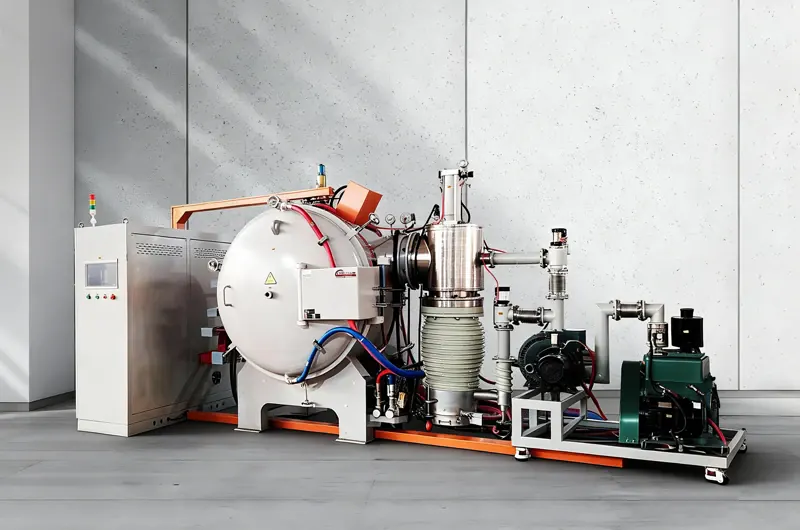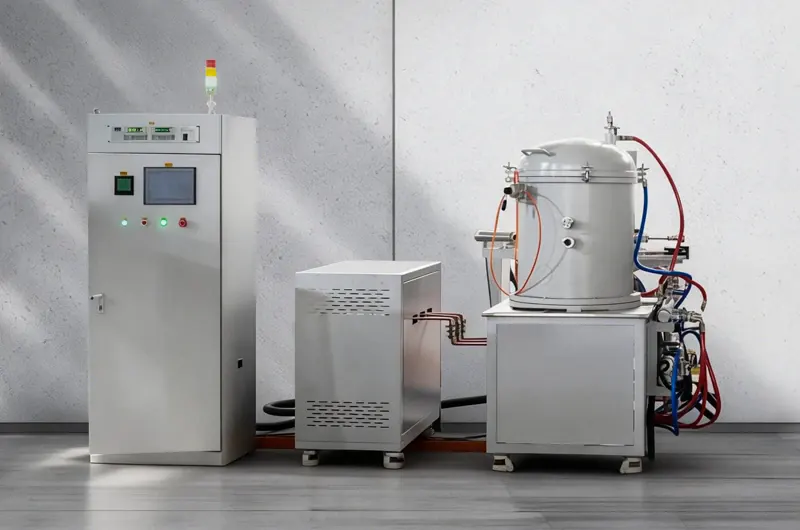
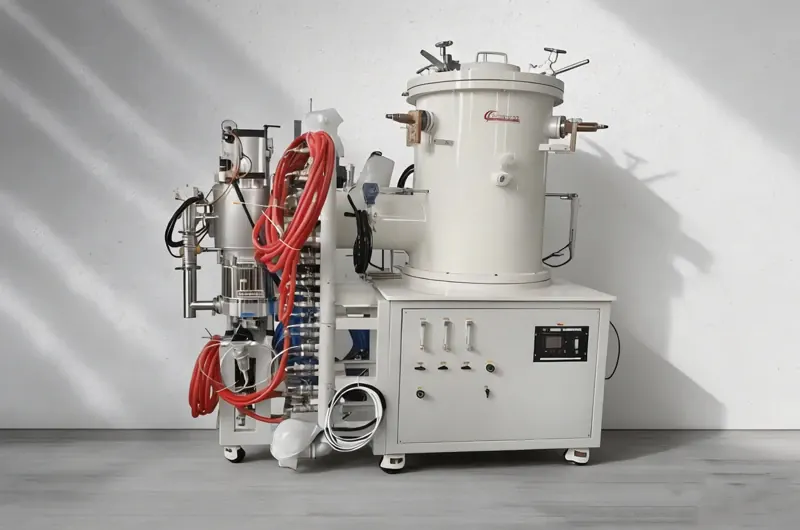
A vacuum tungsten wire sintering furnace is a vertical, bottom-loading furnace with a cage of tungsten wire or rod elements that reaches 2800 °C with no carbon anywhere in the hot zone. It exists for refractory metals and for the small group of materials that have to be processed at the very top of the temperature range in a clean atmosphere.
Why tungsten wire, and why vertical
Tungsten melts at 3422 °C, which is the highest of any metal, and it is the only element material that stays mechanically useful at 2800 °C. Graphite gets there more cheaply, and it is the reason graphite furnaces dominate everything below 2200 °C. What graphite cannot do is stay out of the process. At 2500 °C a graphite hot zone puts a substantial partial pressure of carbon vapour into the chamber, and for tungsten, tantalum and niobium work that vapour is a contaminant rather than an irrelevance.
The vertical arrangement follows from the parts. Refractory metal work is heavy and often long: tungsten rods and plates, molybdenum sputtering targets, tantalum liners, tungsten heavy alloy billets. Loading something like that through a front door means threading it past the elements and the insulation, and the first time a billet brushes against a shield it does measurable damage. A bottom hearth on a hydraulic lift moves the load straight up into a cylindrical hot zone with clearance on every side, and it does so with a crane or a forklift rather than with two people and a jig.
Height also helps the thermal design. A tall cylinder of tungsten elements radiating inward produces a naturally even temperature field over its central section, and the hearth the load sits on can be heated separately, which matters when the part is dense and slow to follow the chamber.
What goes into it
| Material | Typical parts | Temperature | Atmosphere |
|---|---|---|---|
| Tungsten | Rods, plates, crucibles, heavy alloy billets | 2300 – 2800 °C | Vacuum, H₂ |
| Molybdenum | Large plates, tubes, sputtering targets | 2000 – 2500 °C | Vacuum, H₂ |
| Tantalum | Capacitor anodes, liners, fabricated parts | 2000 – 2500 °C | Vacuum |
| Niobium | Superconducting cavities, alloy billets | 1800 – 2300 °C | Vacuum |
| Tungsten heavy alloys (W-Ni-Fe, W-Ni-Cu) | Counterweights, radiation shielding | 1450 – 1550 °C | Vacuum, H₂ |
| Ultra-high-temperature ceramics | ZrO₂, HfO₂, UHTC samples | 2000 – 2600 °C | Vacuum, Ar |
| Cermets requiring a carbon-free cycle | TiC and Ti(C,N) based grades | 1450 – 1650 °C | Vacuum |
The first four rows are the reason the furnace exists. The last three are where buyers discover they need it: a cermet grade that will not tolerate carbon, or a ceramic that has to be sintered above the ceiling of every other carbon-free option.
Specifications
| Parameter | Unit | Range |
|---|---|---|
| Maximum temperature | °C | 2800 |
| Continuous working temperature | °C | 2200 – 2600 |
| Hot zone diameter | mm | 300 – 1200 |
| Hot zone height | mm | 400 – 1500 |
| Charge weight | kg | 50 – 1500 |
| Ultimate vacuum | Pa | 1 × 10⁻³, 5 × 10⁻⁴ with a diffusion pump |
| Leak-up rate | Pa/h | 0.67 or better |
| Temperature uniformity | ± °C | ± 8 at 2000 °C in the central working volume |
| Heating elements | — | Tungsten wire or rod, hung in a cylindrical cage |
| Shielding | — | Tungsten and molybdenum radiation shields, 3 – 6 layers |
| Power supply | — | Low-voltage, high-current transformer, 80 – 400 kVA |
| Temperature sensing | — | Type C thermocouple to 2300 °C, infrared pyrometer above |
| Loading | — | Bottom hearth on a hydraulic or screw lift |
| Atmosphere | — | Vacuum, Ar, N₂, H₂ |
| Cooling | — | Water-cooled shell, flanges and hearth; radiation cooling under vacuum |
The installed power figure explains most of the running cost. A radiation-shielded hot zone made of tungsten and molybdenum returns far less heat than the graphite felt stack of a vacuum graphite sintering furnace, so a vacuum tungsten wire sintering furnace of modest volume draws several times the connected load of a graphite furnace with the same working space. Budget for it, and budget for the transformer and the supply capacity to feed it.
Where tungsten actually wears out
Tungsten elements in a vacuum tungsten wire sintering furnace do not fail at the hot end. They fail wherever the temperature gradient is steepest, which is at the supports and at the current-carrying joints, and the mechanism is worth understanding because most of it is controllable.
Evaporation sets the element life. Above roughly 2000 °C, tungsten leaves the surface continuously, and the rate climbs steeply with temperature and with how good the vacuum is. An element run at 2700 °C in 10⁻³ Pa will lose measurable cross-section over a few hundred hours, and it will fail at whichever point was thinnest to begin with. A partial pressure of 10 to 100 Pa of argon or nitrogen suppresses the evaporation considerably and is standard practice at the top of the range, at the cost of some temperature ceiling.
The joints fail next. Tungsten is not welded to its supports; it is clamped, pinned or hung, and those points are both the coolest part of the element and the places where mechanical stress concentrates. A hairline crack at a clamp runs across the wire and the element drops. This is why element replacement in a tungsten furnace is usually a set, not a single piece: replacing one element against five aged ones changes the current distribution and moves the failure to the next weakest point.
Carbon is the trap that catches people who are new to this furnace. Tungsten in contact with graphite above about 1400 °C forms tungsten carbide, and the reaction makes the metal brittle and changes its resistance. That means no graphite trays, no graphite hearth, no graphite felt, and no graphite fasteners anywhere in a hot zone that gets above that temperature. A single graphite piece left in the chamber will fail the elements it touches, and the visible symptom — a broken element with a grey or dull surface at the fracture — looks like a mechanical fault when it is a chemistry problem.
Handling does the rest. Tungsten is brittle at room temperature, so an element that is dropped, bent or scratched during installation is a failure waiting for its first thermal cycle. Assembly should be done with gloves, without leverage, and with the element supported as it goes in.
With all of that respected, element life in a well-run furnace is 12 to 24 months at moderate duty and 8 to 12 months at the top of the range. The three habits that extend it are a slow first ramp, a leak-up check before every cycle, and never letting the furnace reach full power before the vacuum has settled.
How it compares at the top of the range
| Tungsten wire, vertical | Graphite carbon tube | Graphite box, special build | |
|---|---|---|---|
| Temperature ceiling | 2800 °C | 2400 °C | 2800 °C |
| Largest part it takes | Up to 1200 mm diameter, 1500 mm tall | 200 mm bore | 900 × 900 × 1500 mm |
| How the load enters | From below, on a hearth | Through one end | Front door, on trays |
| Carbon in the chamber | None | Yes | Yes |
| Installed power for the volume | Highest | Low | Lowest |
| Heat-up to working temperature | 3 – 6 h | 30 – 60 min | 2 – 4 h |
| Buy it when | Large refractory parts with no carbon allowed | Small parts up to 2400 °C | High temperature plus volume, carbon acceptable |
The comparison makes the choice straightforward in most cases. Carbon is acceptable and the part is small, so a graphite carbon tube furnace wins on price and speed. Carbon is acceptable and the part is large, so a vacuum graphite sintering furnace wins. Carbon is not acceptable and the part is small, so a molybdenum strip vacuum sintering furnace takes it at 1600 °C. Only when the part is large and carbon is not acceptable does a vacuum tungsten wire sintering furnace become the only option in the range, and that is a narrow but very specific requirement.
What this furnace cannot do
Small parts are a waste of money here. If the work fits through a 200 mm bore, a graphite carbon tube furnace will do it at 2400 °C for a fraction of the capital cost and a fraction of the power, provided the material tolerates carbon. For carbon-sensitive parts below 1600 °C, a molybdenum strip vacuum sintering furnace is the cheaper route to the same chamber chemistry.
Fast cycles are a second limit. A tungsten and molybdenum shield stack is heavy and absorbs heat, so cooling from 2600 °C takes many hours and cannot be accelerated much by gas because the backfill would attack the elements. Processes that live or die on cooling rate do not belong here.
Pressure-assisted densification is a third. A vacuum tungsten wire sintering furnace sinters under vacuum or a controlled atmosphere. It does not apply gas pressure to close porosity, and it does not press. For that you need a vacuum Sinter-HIP furnace or a vacuum hot press furnace, both of which are separate machines.
Finally, carbon-bearing processes are out by design. There is no way to run a carburising or graphitising cycle in a furnace whose elements cannot tolerate carbon at temperature.
Questions buyers ask
Can I put graphite fixtures inside a tungsten furnace?
Not in the hot zone, and not at any temperature above roughly 1400 °C. Tungsten in contact with graphite forms tungsten carbide, which makes the element brittle and changes its electrical behaviour. Use tungsten, molybdenum or ceramic fixtures instead.
Why does my tungsten element keep breaking?
Look at where it broke. A crack at a clamp or support is a mechanical or assembly problem. A break in the hot section with a dull, discoloured surface is evaporation or a carbon reaction, and the fix is a better vacuum or the removal of a graphite part from the chamber.
What is the maximum temperature?
2800 °C is the ceiling of a vacuum tungsten wire sintering furnace, with 2200 to 2600 °C as the continuous working band. Running at the ceiling shortens element life sharply, and a partial pressure of argon or nitrogen during the hold is the usual way to trade a little temperature for a lot more element life.
Can it run hydrogen?
Yes, and hydrogen is a common atmosphere for tungsten and heavy alloy work because it reduces surface oxides. It requires a proper gas train, burn-off and interlocks, and it has to be specified when the furnace is ordered.
How much power does it need?
Between 80 and 400 kVA depending on hot zone size, which is several times a graphite furnace of the same volume. Radiation shields do not insulate as well as graphite felt, so the connected load is a real part of the project rather than a detail.
How long does it take to reach 2800 °C?
Three to six hours from cold, and the last few hundred degrees take longer than the first two thousand. A slow ramp is not a limitation to be engineered away: it protects the elements, and running it faster costs more in replacements than it saves in cycle time.
Is it suitable for tungsten heavy alloys?
It will process them, though the sintering temperature for W-Ni-Fe and W-Ni-Cu is only 1450 to 1550 °C, which is well inside the range of a cheaper furnace. Buy this one for heavy alloys only if the same furnace also has to run true refractory metal work at 2500 °C and above.
What vacuum is needed?
Working vacuum of 1 × 10⁻² Pa or better before the elements reach full power, with a leak-up rate of 0.67 Pa/h or better. At 2500 °C and above, a partial pressure of argon or nitrogen is usually more useful than the deepest vacuum you can pull.
Next step
Tell us the material, the largest part, the load weight and the temperature you need. If the part is large, the material is carbon-sensitive and the temperature is above 2200 °C, a vacuum tungsten wire sintering furnace is the answer and we will size the hot zone, the hearth and the pump set around your load. If two of those three do not apply, we will point you at a cheaper unit in the vacuum sintering furnace range and explain why it will do the job.