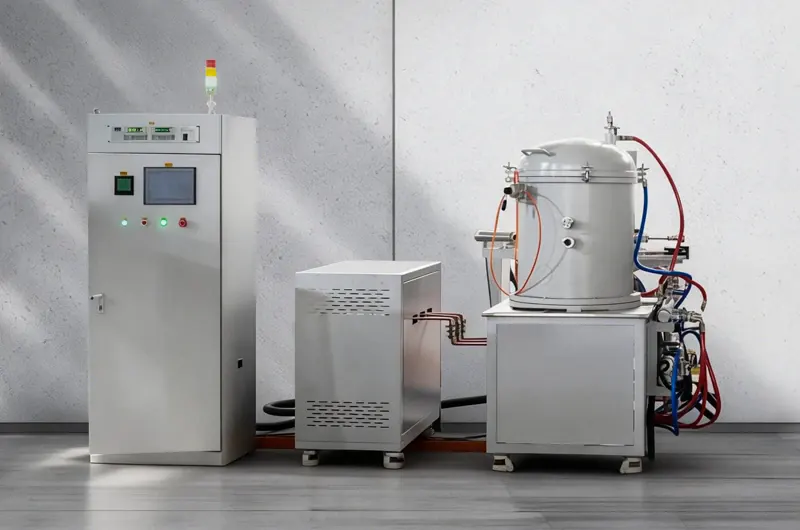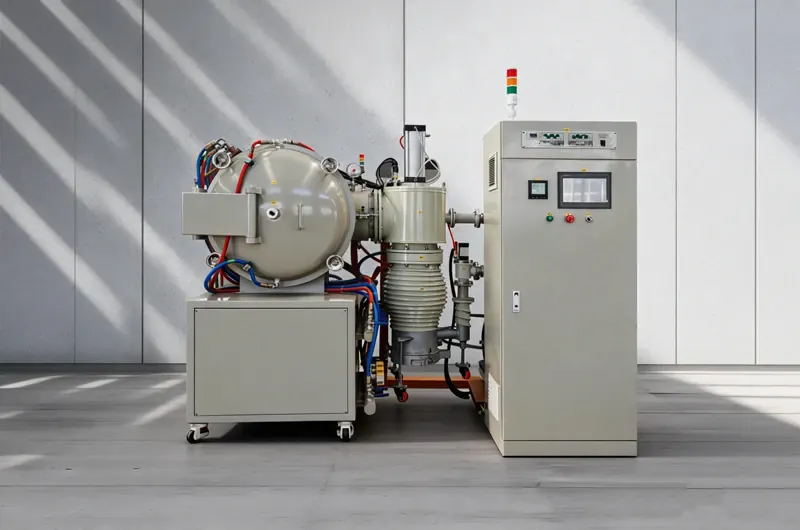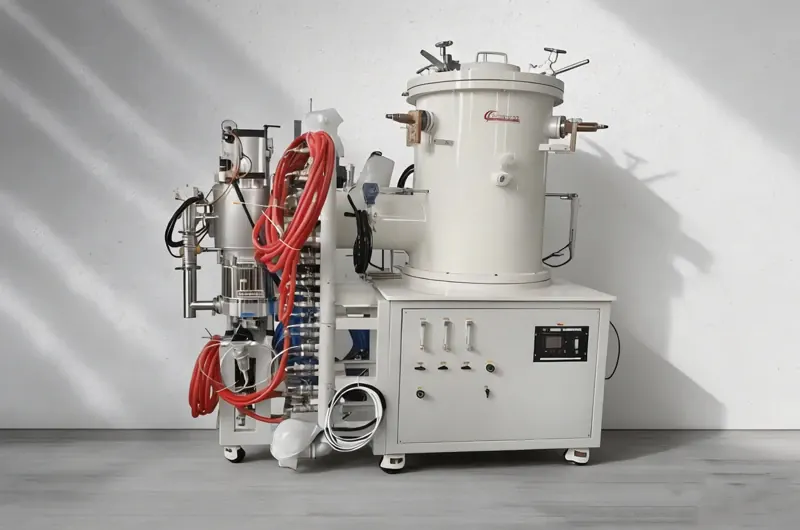
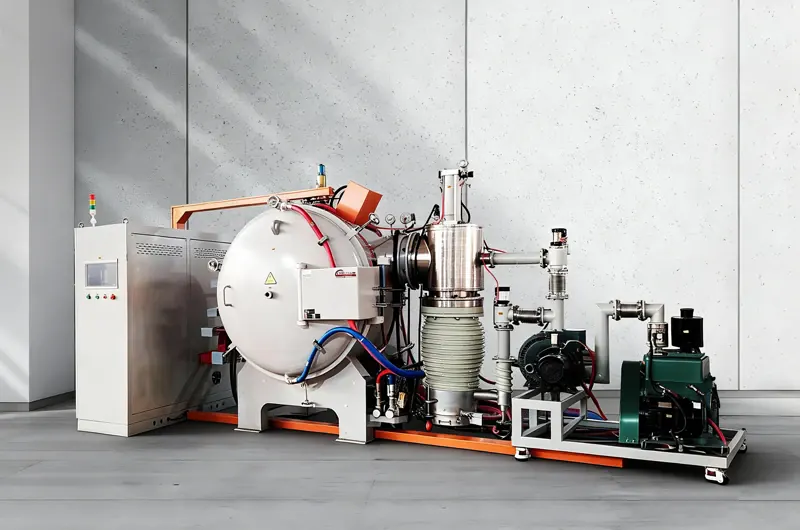
A vacuum graphite sintering furnace is a horizontal batch furnace with a graphite felt hot zone that covers the widest range of production sintering work at 1600 to 2200 °C. It is the machine most buyers end up with, because it is the one that handles cemented carbide, MIM stainless steel, magnets, oxide ceramics and refractory metal heavy alloys without changing anything except the recipe.
What it processes
| Material | Typical parts | Temperature | Atmosphere |
|---|---|---|---|
| Cemented carbide | Inserts, rods, dies, mining buttons | 1380 – 1480 °C | Vacuum, or vacuum plus partial H₂ |
| MIM stainless and low-alloy steel | 316L, 17-4PH, 420 medical and firearm parts | 1250 – 1380 °C | Vacuum, Ar, H₂ |
| Hard magnets | NdFeB and SmCo blocks | 1000 – 1150 °C | Vacuum |
| Soft magnetic alloys | FeSi, FeNi and FeCo laminations | 1100 – 1300 °C | Vacuum / H₂ |
| Oxide ceramics | Al₂O₃, ZrO₂, YAG, spinel | 1450 – 1750 °C | Vacuum / Ar |
| Non-oxide ceramics | SiC, Si₃N₄, TiC, WC-Co composites | 1700 – 2100 °C | Vacuum / Ar |
| Refractory metal heavy alloys | W-Ni-Fe and W-Ni-Cu counterweights | 1400 – 1550 °C | Vacuum / H₂ |
| Carbon materials | Graphite blocks, C/C composite parts | 2000 – 2200 °C | Vacuum / Ar |
| Copper and copper alloys | Cu-Cr and Cu-W contacts | 900 – 1100 °C | Vacuum / H₂ |
The list is long because the graphite hot zone of a vacuum graphite sintering furnace is chemically indifferent to most of it. Carbon is already present in cemented carbide and in steel, so a little carbon vapour in the chamber changes nothing. The materials that break this rule are titanium, zirconium, tantalum, transparent ceramics and anything destined for a medical implant, and they are covered further down rather than in the table. For those, a graphite furnace is not a compromise. It is the wrong machine.
Hot zone sizes and what they will carry
| Usable hot zone (W × H × D) | Maximum temperature | Charge weight | Connected load | Ultimate vacuum | Heat-up to 1800 °C |
|---|---|---|---|---|---|
| 300 × 300 × 600 mm | 2200 °C | 20 – 40 kg | 60 kW | 1 × 10⁻³ Pa | 50 – 70 min |
| 450 × 450 × 900 mm | 2200 °C | 50 – 100 kg | 90 kW | 1 × 10⁻³ Pa | 70 – 100 min |
| 600 × 600 × 900 mm | 2200 °C | 100 – 200 kg | 120 kW | 1 × 10⁻³ Pa | 90 – 120 min |
| 600 × 600 × 1200 mm | 2200 °C | 150 – 300 kg | 150 kW | 1 × 10⁻³ Pa | 110 – 150 min |
| 900 × 900 × 1500 mm | 2200 °C | 300 – 700 kg | 240 kW | 5 × 10⁻⁴ Pa | 150 – 200 min |
Outside the size columns, the numbers that matter are these. Temperature uniformity on a vacuum graphite sintering furnace is typically ± 5 °C at 1200 °C and ± 8 °C at 1800 °C across the working volume. Leak-up rate is 0.67 Pa/h or better on a healthy furnace, and it is the single best indicator of overall condition. Insulation is graphite felt, rigid graphite board, or a felt and board combination. Elements are graphite rod, tube or CFC, arranged on three or four sides plus the door. Backfill cooling runs between 2 and 10 bar of nitrogen or argon, and control is a PLC with recipe storage, over-temperature protection and a water-flow interlock.
Read the charge weight column as a range, not a rating. A 600 × 600 × 900 mm furnace takes 200 kg of dense carbide blocks and less of a light, bulky ceramic load, because the limit is how much mass the elements can bring to temperature, not what the hearth can physically hold.
Inside the hot zone
Graphite felt is the default insulation and the reason this furnace is cheap per litre of usable volume. It comes in 10 to 20 mm blankets, or in rigid board form where the hot zone needs to keep its shape, and its thermal conductivity falls as the pressure drops, so vacuum is a large part of what makes it work. The felt is not in the hot zone proper; it sits behind a graphite or CFC liner that protects it from radiation and from the load.
Element placement decides uniformity more than element type. A furnace with elements only on two side walls will run cooler at the door and at the hearth, which is acceptable for a single row of parts on a central tray and not acceptable for a fully loaded chamber. Four-side heating with a separate door and hearth set costs more and is the configuration to ask for when the load fills the furnace.
Nothing in the hot zone is permanent. Felt, board, elements, hearth and even the loading trays are consumables with different service lives, which is why the maintenance calendar for a vacuum graphite sintering furnace matters more than it does on a molybdenum furnace. The interval table further down gives the numbers.
Vacuum system and how it shapes the cycle
The pump set is normally a rotary vane backing pump, a Roots blower and either a diffusion pump or a turbomolecular pump. Which of those two you get is the main cost decision at the front of the project.
A diffusion pump reaches 5 × 10⁻⁴ Pa and costs less to buy and to rebuild, but it needs clean oil, it takes 20 to 30 minutes to warm up, and it cannot be opened to atmosphere while hot. A turbomolecular pump reaches the same pressure, starts in seconds, tolerates a rougher cycle and costs considerably more. For a furnace running one shift a day, the diffusion pump is usually the right answer. For a furnace that cycles several times a day, or one that has to be opened and reloaded between short cycles, the turbo pays for itself in uptime.
Partial pressure is the other half of the vacuum design and it is often ignored at the specification stage. Introducing a small flow of nitrogen or argon at 10 to 100 Pa during the high-temperature hold suppresses the evaporation of graphite and keeps the chamber cleaner, and on cemented carbide it also helps control cobalt loss at the surface. The mass flow controller that delivers it is inexpensive and should be part of the original order, because retrofitting gas control into a working furnace is a bigger job than it looks.
That gas control earns its keep on carbide inserts. Cobalt evaporating out of the surface layer leaves a binder-poor skin that has to be ground away before the insert will cut, so partial pressure that keeps cobalt in place is tool life recovered. Shops running the same grade every day tune this once and then leave it alone, which is why it belongs in the original specification rather than a later upgrade.
Pressure also has to be coordinated with cooling. Backfilling to 2 bar while the load is still at 1600 °C cools the surface faster than the core and leaves a gradient across a thick part, and the symptom appears much later as distortion rather than as a hardness problem. The safe sequence is to hold vacuum until the load passes roughly 1200 °C, then admit gas.
How it compares with the rest of the range
| If your requirement is… | Choose | Why |
|---|---|---|
| Lowest cost per litre of hot zone, carbon acceptable | Graphite box furnace | Felt insulation and graphite elements are the cheapest way to fill volume |
| No carbon anywhere in the chamber at 1600 °C | Molybdenum strip furnace | All-metal radiation shields, no carbon source at all |
| Highest temperature on small or slender parts | Graphite carbon tube furnace | Direct tube heating with very low thermal mass |
| 2800 °C on large refractory metal parts, loaded from below | Tungsten wire furnace | Wire elements in a vertical, bottom-loading chamber |
| Fast turnaround on small clean samples below 1400 °C | Ceramic fiber furnace | Low thermal mass, no carbon, small footprint |
| Residual porosity must be closed after sintering | Sinter-HIP furnace | Adds 1 – 10 MPa of argon at the sintering temperature |
| Debinding and sintering in one thermal cycle | Debinding and sintering furnace | Handles the binder burn-out stage before the vacuum stage |
Six of those seven alternatives are different machines rather than upgrades to this one, which is worth understanding before a specification is written. A graphite box furnace is not a stepping stone toward a Sinter-HIP furnace; they do different things to the same part, and a workshop that makes carbide cutting tools usually needs both.
Consumables and the maintenance calendar
| Component | Inspect | Typical life | Sign it is due |
|---|---|---|---|
| Graphite felt insulation | Every 6 months | 2 – 4 years | Shrinking, powdering, or dark deposits near the door |
| Heating elements | Monthly, visual | 1 – 3 years | Rising resistance, visible hot spots, more power for the same profile |
| Hearth and loading trays | Every campaign | 6 – 18 months | Warping, sagging, or a load that no longer sits flat |
| Thermocouples | Monthly check | 6 – 18 months | Drift against the reference, or a reading that lags the setpoint |
| Door O-ring and seals | Every opening | 1 – 2 years | Rising leak-up rate, or a pump-down that takes longer |
| Diffusion pump oil | Quarterly | 6 – 12 months | Discoloration, or a slower climb to working vacuum |
| Cooling water filters | Monthly | 3 – 6 months | Rising outlet temperature at unchanged flow |
The power draw is the tell for the whole hot zone. A graphite felt stack shrinks as it ages, and a thinner stack loses more heat, so the furnace needs more current for the same temperature. Watch the figure against a reference cycle once a month. A creep of 10 to 15 % across a year means the felt has compacted and the insulation is on its way out, usually long before anything looks visibly wrong.
Two handling rules prevent most early failures. Never clean graphite parts with a wire brush or any metal tool, because a scratched graphite surface spalls in service and the debris ends up across the insulators. And check the contact between the loading trays and the hearth each campaign, since a tray that has warped enough to sit on three corners instead of four creates a local heat path that shortens element life at that spot.
What a graphite furnace will not do
Titanium, zirconium, tantalum and their alloys are out. All of them pick up carbon, and titanium in particular becomes brittle at levels low enough that the part still looks right and fails in service. A molybdenum strip vacuum sintering furnace exists for exactly these materials.
Transparent ceramics are out for a related reason. In YAG, spinel or AlON, a small amount of carbon creates oxygen vacancies and the part turns grey or cloudy, and the defect cannot be polished out because it is a bulk property, not a surface one.
Densification is out. A vacuum graphite sintering furnace holds a temperature and sinters; it does not apply pressure. Any specification that asks for closed porosity to be eliminated needs a vacuum Sinter-HIP furnace or a hot press, and those are separate purchases.
Fast cooling is out as well. A felt-insulated hot zone holds its heat, so cooling from 1800 °C to a few hundred degrees takes several hours under vacuum and 1 to 3 hours with forced gas. If the process depends on a quench-like cooling rate, that is a heat treatment furnace rather than a sintering furnace.
Questions buyers ask
Can a graphite furnace sinter titanium?
No. Titanium picks up carbon from the hot zone and becomes brittle, and the contamination is not visible on the finished part. Titanium and its alloys need an all-metal hot zone.
What vacuum level does cemented carbide sintering need?
Working vacuum between 1 × 10⁻¹ and 1 × 10⁻² Pa during the high-temperature hold is typical, with a leak-up rate of 0.67 Pa/h or better before the cycle starts. Deeper vacuum is not usually required and can increase cobalt loss from the surface.
Why is my furnace drawing more power than it used to?
Almost always compacted insulation. Graphite felt shrinks with thermal cycling, and a thinner felt stack loses more heat, so the elements need more current for the same temperature. A 10 to 15 % rise across a year means the insulation is due.
Can I run hydrogen in a graphite furnace?
Yes, and it is common practice on cemented carbide and on refractory metal heavy alloys, because hydrogen reduces surface oxides. It requires a properly designed gas train, an exhaust burn-off, and interlocks that prevent hydrogen from entering the chamber before the temperature and oxygen conditions are safe.
How long does the graphite felt last?
Two to four years in normal production. The interval shortens sharply if the furnace is opened hot, if the load touches the insulation, or if the vacuum is consistently poor.
Soft felt or rigid graphite board?
Felt is cheaper, insulates better and is easier to replace in sections. Rigid board holds its shape, resists the load brushing against it, and is worth the premium where the hot zone is loaded close to the walls or where the felt would otherwise sag.
Can one furnace do debinding as well as sintering?
Only with the right exhaust design. Binder vapour attacks the insulation and condenses in cold pipework, so a vacuum graphite sintering furnace asked to do both stages needs an afterburner and a heated exhaust line. If debinding is a large part of the process, a dedicated debinding and sintering furnace is the better purchase.
Next step
Give us the material, the largest part, the batch weight and the target temperature, and we will size a vacuum graphite sintering furnace and its pump set around that load. If the process needs a carbon-free atmosphere, pressure-assisted densification or a higher ceiling, we will point you at the right unit in the vacuum sintering furnace range instead of selling you a graphite furnace that will not do the job.