
40%
Energy Saving vs Brick-Lined
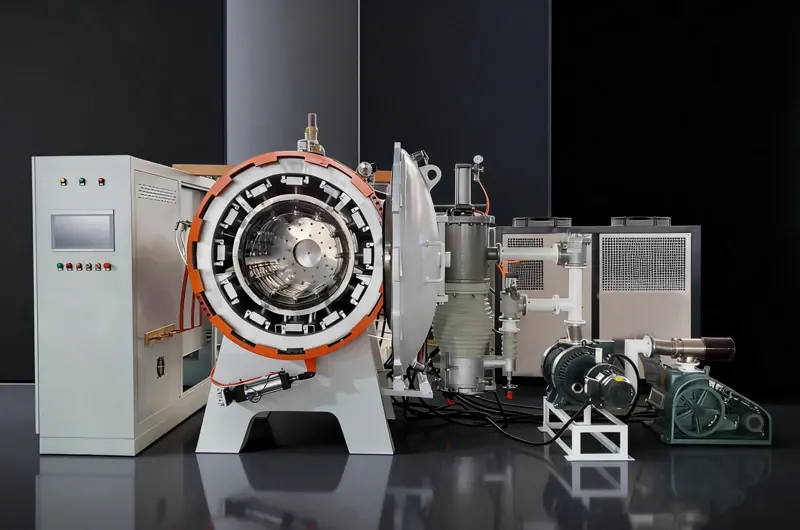
Both furnace types share the same pressure vessel, vacuum pump set, and gas-quench circuit. The only structural difference is the hot zone. Select the configuration that matches your material's sensitivity to carbon contamination.
Model: BR-QCL-G Series
High power density · Cost-efficient · Broad material compatibility
High-purity graphite tubes. Excellent thermal shock resistance; operable up to 1350°C with minimal element degradation over service life.
Graphite soft felt + rigid graphite board composite. Low thermal mass enables rapid heat-up and cool-down cycles.
Model: BR-QCL-M Series
Zero carbon · Ultra-clean atmosphere · Precision aerospace & medical
Molybdenum strip elements. Zero carbon emission at any temperature; ideal for materials where surface chemistry must be preserved exactly as-designed.
Multi-layer molybdenum foil radiation shields. Achieves equivalent insulation performance to graphite felt while maintaining a completely carbon-free environment.
All furnace sizes share identical performance ratings. Chamber dimensions and load capacity scale with the size you select.
All sizes deliver identical performance. Select by the largest workpiece you need to process and your target batch weight. Every size is available with either a graphite or molybdenum hot zone.
| Chamber Size | Inner Dimensions (Ø × H) | Max Load | Installed Power | Typical Application |
|---|---|---|---|---|
| BR-QCL-334 G/M | Ø300 × 450 mm | 100 kg | 50 kW | R&D samples, small precision parts, prototype batches |
| BR-QCL-446 G/M | Ø400 × 600 mm | 200 kg | 80 kW | Small tooling, cutting inserts, medical instruments |
| BR-QCL-557 G/M | Ø500 × 700 mm | 400 kg | 120 kW | Medium molds, aerospace brackets, batch production |
| BR-QCL-669 G/M | Ø600 × 900 mm | 600 kg | 180 kW | Large die sets, turbine discs, structural forgings |
| BR-QCL-8812 G/M | Ø800 × 1200 mm | 900 kg | 260 kW | Heavy molds, large aerospace components, high-volume production |
Custom chamber dimensions and load capacities are available. Contact our engineering team with your workpiece drawings for a tailored recommendation.
Starting-point parameters for common materials processed in our vacuum gas quenching furnaces. Final parameters should be validated against your specific part geometry, section thickness, and metallurgical requirements.
| Material | Grade Examples | Recommended Hot Zone | Hardening Temperature | Gas Quench Pressure | Quench Gas |
|---|---|---|---|---|---|
| Hot-work tool steel | H13, H11, H21 | Graphite | 1020–1050°C | 6–8 bar | N₂ |
| High-speed steel | M2, M42, T1 | Graphite | 1200–1230°C | 8–10 bar | N₂ |
| Cold-work tool steel | D2, D3, Cr12MoV | Graphite | 1000–1040°C | 6–8 bar | N₂ |
| Plastic mold steel | P20, 718, NAK80 | Graphite | 850–900°C | 4–6 bar | N₂ |
| Austenitic stainless steel | 304, 316L | Molybdenum | 1050–1080°C | 5–6 bar | N₂ or Ar |
| Precipitation-hardening stainless | 17-4PH, 15-5PH | Molybdenum | 1040°C (solution) + 480°C (age) | 4–6 bar | N₂ |
| Titanium alloy | TC4 (Ti-6Al-4V), TA15 | Molybdenum | 900–950°C | 3–5 bar | Ar |
| Nickel-base superalloy | IN718, IN625, GH4169 | Molybdenum | 980–1080°C | 5–8 bar | Ar |
Vacuum gas quenching eliminates the oxidation, decarburization, and quench media contamination inherent in oil and salt-bath processes — while delivering distortion levels that conventional methods cannot match.
Uniform gas impingement from all directions produces symmetric cooling gradients. Compared to oil quenching, dimensional distortion is typically reduced by 60–80%, significantly cutting post-heat-treatment grinding allowances and scrap rates.
Processing under high vacuum eliminates oxygen and moisture entirely. Parts exit the furnace with a clean, bright metallic surface — no oxidation, no decarburization, no post-process cleaning or acid pickling required.
The 1–10 bar variable-pressure system lets you dial in exactly the cooling rate your metallurgy demands — gentle enough for thin-wall geometries at 2 bar, aggressive enough to fully harden large cross-sections at 10 bar.
Gas quenching requires no oil, salt, or polymer quenchant. There is no fire hazard, no wastewater treatment, and no hazardous waste disposal cost — reducing both environmental liability and ongoing operating expense.
| Criterion | Vacuum Gas Quenching | Oil Quenching | Salt Bath |
|---|---|---|---|
| Surface oxidation | None | MModerate | Low |
| Decarburization | None | Possible | Minimal |
| Dimensional distortion | Very low | High | Medium |
| Post-process cleaning | Not required | Required | Required |
| Quench rate control | Stepless 1–10 bar | Limited | Limited |
| Environmental / safety | Clean, no hazardous waste | Fire risk, waste oil | Toxic salt disposal |
| Carbon-sensitive materials | Molybdenum hot zone: fully compatible | Not recommended | Depends on salt type |
Every vacuum gas quenching furnace is delivered as a complete, integrated system — fully assembled, tested, and certified before shipment.
Answers to the questions our customers ask most often about the BR-22STV vacuum graphite carbon tube sintering furnace.
For most air-hardening and high-alloy tool steels — including H13, D2, M2, and P20 — gas quenching at 6–10 bar delivers equivalent or superior hardness to oil quenching, with significantly lower distortion. For low-alloy steels that require very fast quench rates (e.g., water-hardening grades), oil or polymer quenching may still be required. Our engineering team can advise based on your specific grade and section size.
The graphite hot zone uses graphite heating elements and felt insulation. It is cost-effective and suitable for the majority of tool steels, die steels, and general industrial alloys. However, at high temperatures, the graphite components produce a trace carbon atmosphere inside the chamber.
The molybdenum hot zone uses molybdenum strip elements and multi-layer foil radiation shields. It produces zero carbon at any temperature, making it the correct choice for titanium alloys, nickel superalloys, medical-grade stainless steels, and any material where carbon contamination would compromise the final properties. The molybdenum configuration carries a higher initial cost.
Typical utility requirements are as follows. Exact values depend on the furnace size selected:
A full site preparation checklist is provided upon order confirmation.
Yes. Because both hot zone types are designed as modular assemblies within the same pressure vessel, field conversion from graphite to molybdenum is technically possible. This requires a scheduled maintenance window, a replacement hot-zone kit, and on-site commissioning by a Brother Furnace technician. If you anticipate processing both carbon-sensitive and standard materials in the future, we recommend discussing a dual-hot-zone strategy at the time of purchase.
All vacuum gas quenching furnaces are covered by a 2-year warranty on the complete machine. Brother Furnace provides on-site installation and commissioning, operator training, and a spare parts package with each unit. Remote diagnostics via the HMI network interface are available for real-time troubleshooting. Extended service contracts and annual preventive maintenance programs are available upon request.
Under normal vacuum or inert gas operation, graphite hot zone components last 12–18 months with continuous production use. Molybdenum hot zones have a longer service life of 24–36 months due to better high-temperature stability.
Service life depends greatly on operating temperature, frequency of cycling, and avoiding accidental air ingress when the furnace is hot. All hot zones are modular and can be replaced on-site without returning the furnace to the factory.
Standard models: 35–45 working days for production and testing.
Custom models: 55–65 working days.
Shipping takes 15–35 days depending on your location. On-site installation and commissioning typically requires 3–5 working days, including operator training.
Yes. We provide free on-site operator and maintenance training with every furnace purchase. The training covers daily operation, temperature programming, vacuum system logic, safety procedures, routine maintenance, and basic troubleshooting.
An English operation manual, electrical diagram, and maintenance video are also included as standard.
Yes, light regular maintenance ensures stable vacuum performance and long service life.
Recommended maintenance includes monthly inspection of pump oil levels, quarterly oil changes for mechanical pumps, annual inspection of seals and gaskets, and cleaning of heat exchanger surfaces. All maintenance schedules and checklists are provided in the user manual.