- 100% Flux-Free Process
- ±3°C Temperature Uniformity
- Vacuum to 5×10⁻⁴ Pa
- Zero Post-Braze Cleaning
- CE · ISO 9001 Certified
Why Vacuum Quenching
The Same Hardness. Without the Oxidation,
Distortion, or Cleaning.
Conventional quenching in salt baths or open-atmosphere furnaces exposes the workpiece surface to oxygen at high temperature — producing scale, decarburisation, and discolouration that must be removed by shot blasting, acid pickling, or grinding before the part can be used. These post-processing steps add cost, time, and dimensional uncertainty.
Vacuum quenching heats and holds the workpiece in a sealed vacuum chamber, then quenches it in an environment that is completely isolated from atmospheric oxygen. The result is a bright, clean surface that requires no post-quench cleaning — and a more controlled quench that reduces distortion compared to open-bath methods.
-
Bright Surface, No Oxidation
Components exit the furnace with a clean metallic surface. No scale, no decarburisation, no discolouration — eliminating shot blasting and acid cleaning from the post-process workflow.
-
Reduced Distortion
Controlled, uniform heating in vacuum and programmable quench pressure or oil agitation produces more consistent thermal gradients than open-bath quenching — reducing dimensional distortion on precision components.
-
No Hazardous Waste
Vacuum quenching eliminates the salt bath waste disposal problem entirely. Gas quenching produces no liquid waste at all; oil quenching uses a closed oil system with no open-bath hazard.
-
Repeatable, Programmable Process
PLC-controlled heating curves and quench parameters are stored and recalled for each material and part number — delivering batch-to-batch consistency that open-bath processes cannot match.
Gas Quenching vs Oil Quenching
Two Configurations, Two Cooling Philosophies
Both furnaces deliver bright, oxide-free results. The difference is in the cooling medium, the cooling rate, and the materials each configuration is best suited for.
| Criterion | Vacuum Gas Quenching Furnace | Vacuum Oil Quenching Furnace |
|---|---|---|
| Cooling Medium | High-pressure N₂ or Ar gas | Vacuum quench oil (closed system) |
| Cooling Rate | Controlled by gas pressure (2–20 bar) | Fast — comparable to conventional oil quench |
| Surface Condition After Quench | Perfectly bright, no cleaning required | Bright, light oil film — minimal cleaning |
| Distortion Level | Lowest — uniform gas flow around workpiece | Low — better than salt bath, similar to conventional oil |
| Ideal Steel Types | High-alloy tool steels, HSS, stainless, Ti alloys, Ni superalloys | Low-alloy steels, medium-carbon steels, large cross-section parts |
| Typical Applications | Precision moulds, cutting tools, aerospace components | Gears, shafts, structural parts, large dies |
| Post-Quench Cleaning | Not required | Light cleaning recommended |
| Liquid Waste | None | Closed oil system — minimal |
| Combined Quench + Temper Cycle | Supported | Supported |
Our Products
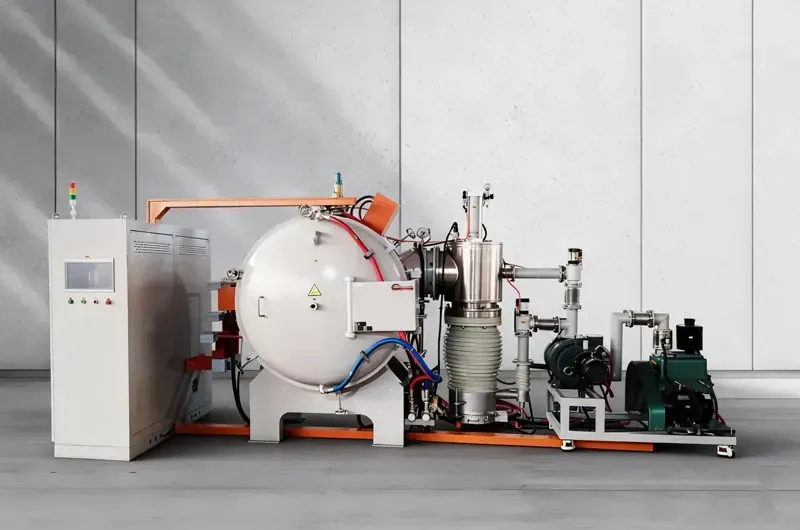
Two Vacuum Quenching Furnace Configurations
Both built on the same platform — horizontal single-chamber design, PLC process control, and full Factory Acceptance Testing before shipment.
Gas Quenching
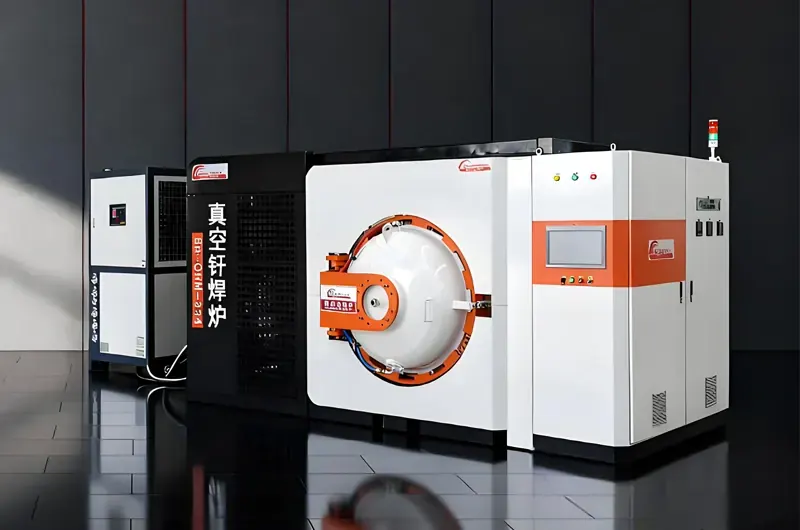
Vacuum Gas Quenching Furnace
High-pressure inert gas cooling for
distortion-critical components and high-alloy steels. The cleanest quench available — no
liquid contact, no post-clean.
Max Temperature
1350°C
Quench Pressure
Up to 10 bar
Ultimate Vacuum
6.67×10⁻³ Pa
Quench Medium
N₂ or Ar
The vacuum gas quenching furnace heats the workpiece
in
high vacuum, then rapidly backfills the chamber with high-pressure nitrogen or argon to
achieve the required cooling rate. Gas pressure is programmable — lower pressure for
distortion-sensitive components, higher pressure for materials requiring faster quench
speeds. No liquid contact means the surface remains perfectly bright with zero cleaning
requirement.
Key Advantages:
- Perfectly bright surface — no post-quench cleaning
- Lowest distortion of any quenching method
- Programmable quench pressure for process flexibility
- Supports combined quench + temper in a single cycle
- No liquid waste — simplest environmental compliance
- Ideal for H13, M2, D2, 17-4PH, Ti-6Al-4V, Inconel
Oil Quenching
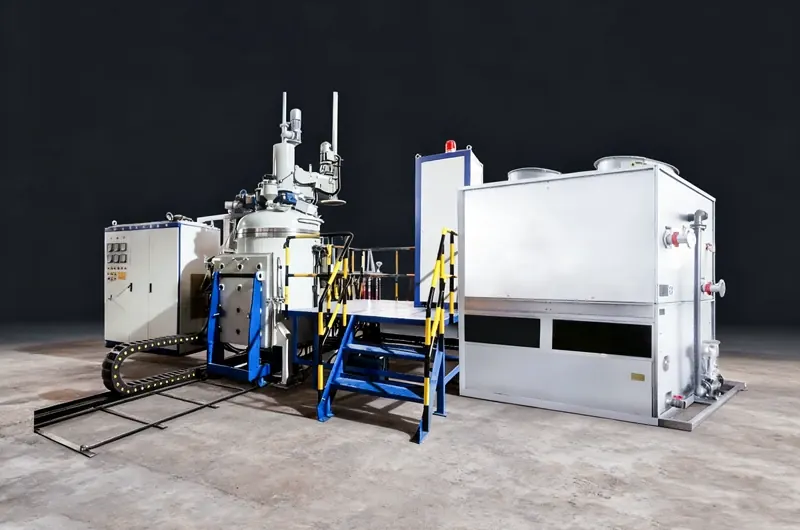
Vacuum Oil Quenching Furnace
Fast oil quenching in a sealed vacuum environment
—
the hardness of conventional oil quenching with the surface quality of vacuum
processing.
Max Temperature
1350°C
Oil System
Closed, agitated
Ultimate Vacuum
6.67×10⁻³ Pa
Quench Medium
Vacuum quench oil
The vacuum oil quenching furnace heats the workpiece
in
high vacuum, then transfers it into a sealed oil quench tank without any atmospheric
exposure. The workpiece is quenched in vacuum quench oil — delivering the fast cooling
rate
required by lower-alloy steels while maintaining a bright, oxide-free surface. The
closed
oil system eliminates the open-bath fire hazard and reduces oil consumption compared to
conventional oil quench tanks.
Key Advantages
- Fast cooling rate — suitable for lower-alloy steels
- Bright surface — heated and quenched without air exposure
- Closed oil system — no open-bath fire hazard
- Oil agitation control for uniform quench severity
- Supports combined quench + temper in a single cycle
- Ideal for 5140, 4140, 8620, P20, large cross-section dies
Material Guide
Find Your Material
Know Which Furnace You Need
Select your material category below to see typical steel grades, recommended quenching method, and indicative process parameters.
-
Tool Steels
Tool steels are the most common application for vacuum quenching furnaces.
High-alloy hot-work tool steels such as H13 and H11 are particularly well-suited to gas quenching — their high alloy content provides sufficient hardenability to achieve full hardness with gas cooling rates, while the uniform gas flow minimises distortion in complex mould geometries.
Cold-work tool steels such as D2 also respond well to gas quenching. Lower-alloy tool steels with simpler geometries may benefit from oil quenching to achieve the required hardness in thicker sections.
| Parameter | Value |
|---|---|
| Austenitising Temperature | 1020–1050°C |
| Vacuum Level (Heating) | 10⁻² – 10⁻³ Pa |
| Soak Time | 30–60 min (section dependent) |
| Quench Method | Gas (N₂), 5–10 bar |
| Target Hardness | 50–54 HRC (before temper) |
| Temper | 560–600°C × 2 cycles |
-
High-Speed Steels
High-speed steels (HSS) such as M2, M42, and T15 require precise austenitising temperatures in the 1180–1260°C range and are highly sensitive to surface decarburisation — making vacuum processing essentially mandatory for quality-critical cutting tool production.
The high alloy content of HSS provides excellent hardenability, and gas quenching at moderate pressure (2–6 bar) is sufficient to achieve full hardness in most cross-sections.
Oil quenching is generally not recommended for HSS due to the risk of thermal shock and cracking in complex tool geometries.
| Parameter | Value |
|---|---|
| Preheat Stages | 550°C + 850°C (two-stage) |
| Austenitising Temperature | 1200–1230°C |
| Vacuum Level (Heating) | 10⁻² – 10⁻³ Pa |
| Soak Time | 5–15 min |
| Quench Method | Gas (N₂), 2–6 bar |
| Target Hardness | 64–66 HRC (after temper) |
| Temper | 540–560°C × 3 cycles |
-
Stainless Steels
Martensitic stainless steels such as 440C, 420, and 17-4PH require solution annealing or hardening in a clean, oxygen-free environment to prevent chromium oxide formation on the surface — which would compromise both corrosion resistance and surface finish.
Vacuum gas quenching is the standard process for these materials in aerospace, medical device, and food equipment manufacturing.
Austenitic stainless steels are solution-annealed in vacuum and gas-quenched to retain the fully austenitic microstructure.
| Parameter | Value |
|---|---|
| Austenitising Temperature | 1010–1065°C |
| Vacuum Level (Heating) | 10⁻² – 10⁻³ Pa |
| Soak Time | 20–40 min |
| Quench Method | Gas (N₂), 4–6 bar |
| Target Hardness | 58–62 HRC (before temper) |
| Temper | 150–180°C × 2 h |
-
Titanium Alloys
Titanium alloys are extremely reactive at elevated temperatures — even trace oxygen or nitrogen in the processing atmosphere will cause surface contamination (alpha case), which embrittles the surface layer and must be removed by chemical milling or machining.
Vacuum solution treatment and gas quenching is the only viable method for processing titanium alloys to aerospace quality standards.
The workpiece must be heated and quenched entirely within the vacuum environment, with no atmospheric exposure at any point in the cycle.
| Parameter | Value |
|---|---|
| Solution Temperature | 900–955°C |
| Vacuum Level (Heating) | 10⁻³ Pa or better |
| Soak Time | 20–60 min (section dependent) |
| Quench Method | Gas (Ar), fast quench |
| Ageing Temperature | 480–600°C |
| Target Tensile Strength | ≥ 1100 MPa (STA) |
-
Nickel Superalloys
Nickel-based superalloys used in aerospace turbine components, industrial gas turbines, and high-temperature fasteners require solution annealing and ageing heat treatments in a clean vacuum environment.
Oxidation during heat treatment would compromise the protective oxide scale and degrade high-temperature corrosion resistance.
Vacuum gas quenching with argon is the standard process for Inconel, Waspaloy, and René series alloys.
The precise temperature control and programmable multi-segment cycles of the vacuum gas quenching furnace are well-matched to the complex heat treatment specifications of these materials.
| Parameter | Value |
|---|---|
| Solution Temperature | 980°C × 1 h |
| Vacuum Level (Heating) | 10⁻² – 10⁻³ Pa |
| Quench Method | Gas (Ar), rapid quench |
| Ageing Stage 1 | 720°C × 8 h |
| Ageing Stage 2 | 620°C × 8 h |
| Target Hardness | 38–44 HRC |
How to Choose
Gas Quenching or Oil Quenching
Which Is Right for You?
Use these criteria to make your decision. If your situation doesn't fit neatly into either column, our engineers will help you choose.
Choose Gas Quenching If...
Your situation matches one or more of these
- Your material is a high-alloy tool steel (H13, D2, A2), HSS, stainless steel, titanium alloy, or nickel superalloy
- Distortion control is critical — precision moulds, thin-walled components, or tight-tolerance parts
- Surface cleanliness is paramount and you want zero post-quench cleaning
- You need to run combined quench + temper cycles without removing parts from the furnace
- Your facility has no liquid waste treatment capability
- You process aerospace, medical, or semiconductor components with strict surface quality requirements
Choose Oil Quenching If...
Your situation matches one or more of these
- Your material is a low-alloy or medium-carbon steel (4140, 5140, 8620) that requires a faster cooling rate than gas can provide
- You are processing large cross-section components where gas quenching cannot achieve sufficient core hardness
- You are currently using a conventional oil quench and want to upgrade to vacuum processing for better surface quality
- Your parts require the hardness depth achievable only with liquid quenching
- You process gears, shafts, or structural components where hardness takes priority over minimal distortion
- Budget is a consideration — oil quenching furnaces have a lower capital cost than high-pressure gas quenching
Not sure which configuration suits your material and process?
Tell us your steel grade, part geometry, and target hardness — our engineers will recommend the right furnace within 24 hours.
FAQ
Frequently Asked Questions
Common questions about vacuum quenching furnaces — covering both gas and oil quenching configurations.
What is the difference between vacuum quenching and conventional quenching?
In conventional quenching, the workpiece is heated in an atmosphere furnace or salt bath and then transferred through open air into a quench tank — exposing the hot surface to oxygen and producing scale, decarburisation, and discolouration. In vacuum quenching, the entire heating and quenching cycle takes place inside a sealed chamber with no atmospheric exposure at any point. The result is a bright, oxide-free surface that requires no post-quench cleaning. Vacuum quenching also produces more uniform thermal gradients during the quench, which reduces distortion — particularly important for precision components such as moulds and cutting tools.
Can the furnace perform tempering as well as quenching?
Yes. Both the gas quenching and oil quenching furnaces support combined quench and temper cycles within a single furnace run. After the quench cycle is complete and the workpiece has cooled to the appropriate transfer temperature, the furnace can be programmed to ramp up to the tempering temperature and hold for the required soak time — all without removing the parts from the chamber. This eliminates the need for a separate tempering furnace and reduces total cycle time. The PLC control system stores the complete quench + temper programme for each material and part number for repeatable recall.
Will vacuum gas quenching achieve the same hardness as oil quenching?
For high-alloy steels — including H13, D2, M2, 440C, and most tool steels and HSS — yes. These materials have sufficient hardenability that the cooling rate achievable with high-pressure gas quenching (typically 5–10 bar N₂) is more than adequate to achieve full martensitic transformation and the specified hardness. For lower-alloy steels with lower hardenability — such as 4140, 5140, or 8620 — gas quenching may not provide a fast enough cooling rate to achieve full hardness in thicker sections, and oil quenching is the better choice. If you are unsure whether gas quenching will achieve your required hardness for a specific material and section size, contact our engineers with the details and we will advise.
How much distortion should I expect compared to salt bath quenching?
Vacuum gas quenching consistently produces lower distortion than salt bath quenching for high-alloy tool steels. The primary reason is the uniformity of the cooling medium — high-pressure gas flows around the entire workpiece surface simultaneously, producing a more symmetric thermal gradient than immersion in a liquid bath. For precision moulds and dies processed in vacuum gas quenching furnaces, dimensional distortion of ≤0.1–0.2 mm per 100 mm is commonly achieved on H13 and D2 tool steels. Actual distortion depends on part geometry, fixture design, and the specific quench pressure and gas flow pattern — our engineers can advise on fixture design for distortion-critical components.
Does vacuum quenching require any special pre-treatment of the workpiece?
Workpieces should be clean and dry before loading — free of machining oils, coolants, and moisture. Residual oils or coolants will outgas during pump-down and heating, increasing the time required to reach the target vacuum level and potentially contaminating the furnace interior. For components with blind holes or deep cavities, ensure that no liquid is trapped inside. No special surface coating or pre-oxidation treatment is required — unlike some atmosphere furnace processes. Workpieces should be loaded on clean stainless steel or molybdenum fixtures to avoid contamination from the fixture material at high temperatures.
What is the typical cycle time for a vacuum quenching run?
A typical vacuum quench cycle for tool steel (H13, D2) consists of: pump-down to working vacuum (15–30 min), staged heating with preheat stops (60–90 min), austenitising soak (30–60 min), and gas quench to below 100°C (30–60 min depending on section size and quench pressure). Total cycle time for a quench-only run is typically 3–5 hours. A combined quench + temper cycle adds 2–4 hours for the tempering stage. Actual cycle times depend on furnace load, part section size, and the specific process requirements of the material.
What utilities are required for installation?
Both furnace configurations require a three-phase five-wire 380V 50Hz electrical supply (rated power varies by model), a cooling water supply at 0.2–0.4 MPa with inlet temperature ≤30°C, and a supply of high-purity N₂ or Ar (for gas quenching) or vacuum quench oil (for oil quenching). A recirculating water chiller is recommended for facilities without a plant cooling water circuit. The gas quenching furnace requires a high-pressure gas storage and delivery system rated for the maximum quench pressure of the selected model. Full utility requirements are specified in the technical documentation provided at the quotation stage.
What warranty and after-sales support is provided?
Every furnace carries a 2-year warranty on the complete system. Remote technical support is provided via video call, email, and WhatsApp with a 24-hour response commitment. Remote video commissioning is included with every order. On-site installation and operator training are available as optional services. Spare parts including heating elements, O-ring seal sets, and vacuum pump consumables are stocked and available for worldwide shipment, typically within 5–10 business days.
Also From Brother Furnace
Related Vacuum Quenching Furnace
Explore our full range of industrial vacuum furnaces — all engineered and manufactured in-house at Brother Furnace.