
40%
Energy Saving vs Brick-Lined
Vacuum annealing eliminates oxygen and moisture from the entire process cycle — heating, soaking, and cooling all take place under high vacuum. The result is a bright, oxide-free surface finish with precisely controlled microstructure, without any post-process cleaning or acid pickling.
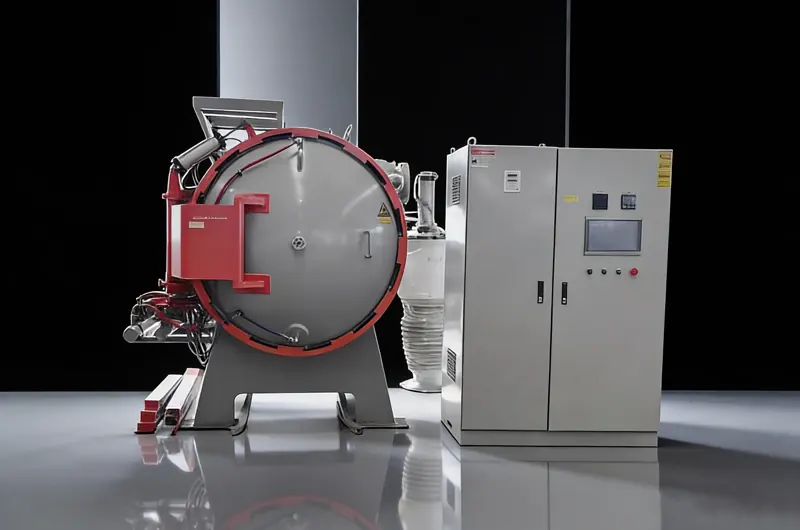
The molybdenum rod heating element is the core of this furnace. Compared to graphite elements, molybdenum produces zero carbon contamination at any temperature — making it the correct choice for materials where surface chemistry and cleanliness are critical, such as titanium alloys, nickel superalloys, and high-purity stainless steels.
The multi-layer stainless steel radiation shield insulation, combined with a double-wall air-cooled furnace shell, keeps the outer shell surface below 50°C during full-power operation — ensuring operator safety and reducing heat loss.
The 7-inch touchscreen HMI provides real-time heating curve display, process program storage, and alarm management — giving operators full visibility and control over every stage of the annealing cycle.
Compared to protective-atmosphere furnaces using nitrogen or hydrogen, vacuum annealing provides a higher degree of surface cleanliness and eliminates any risk of gas-metal reactions — critical for reactive and high-value alloys.
Processing under 7×10⁻³ Pa vacuum completely removes oxygen and moisture. Parts exit the furnace with a clean, bright metallic surface — no oxidation, no discoloration, no post-process cleaning required.
Molybdenum rod heating elements produce no carbon at any temperature. For titanium alloys, nickel superalloys, and medical-grade materials where carbon pickup would alter mechanical properties, this is a critical advantage over graphite-heated furnaces.
The 51-segment programmable temperature controller manages heating rate, soak time, and cooling rate with ±3°C accuracy — ensuring the correct microstructural transformation at every stage of the annealing cycle.
Uniform radiant heating from the molybdenum element array, combined with slow, controlled cooling, produces symmetrical thermal gradients throughout the workpiece — significantly reducing distortion compared to open-atmosphere or salt-bath annealing.
The double-wall air-cooled furnace shell, constructed from high-strength carbon steel with electrostatic powder coating, keeps the outer surface below 50°C during full-power operation — protecting operators and reducing ambient heat load in the workshop.
Standard chamber sizes cover workpieces up to 600×600×900 mm. Custom configurations are available up to 1.8×3 m for large structural components, long shafts, and oversized aerospace parts.
All furnace sizes share identical performance ratings. Chamber dimensions and load capacity scale with the size you select.
All sizes deliver identical performance specifications. Select by your largest workpiece envelope and target batch weight. Custom sizes up to 1.8×3 m are available.
| Chamber Size | Heating Zone (W×H×D) mm | Est. Load Capacity | Power | Power Supply | Ultimate Vacuum |
|---|---|---|---|---|---|
| Small BR-QHM-223 |
200 × 200 × 300 | ~30 kg | 42 kW | 380V | 7×10⁻³ Pa |
| Medium-Small BR-QHM-334 |
300 × 300 × 400 | ~80 kg | 72 kW | 380V | 7×10⁻³ Pa |
| Medium BR-QHM-446 |
400 × 400 × 600 | ~200 kg | 120 kW | 380V | 7×10⁻³ Pa |
| Medium-Large BR-QHM-557 |
500 × 500 × 700 | ~350 kg | 160 kW | 380V | 7×10⁻³ Pa |
| Large BR-QHM-669 |
600 × 600 × 900 | ~600 kg | 225 kW | 380V | 7×10⁻³ Pa |
Load capacity values are estimates based on chamber volume. Actual capacity depends on workpiece geometry and loading configuration. Custom chamber sizes up to 1.8×3 m are available — contact our engineering team with your workpiece drawings.
Every component is selected and engineered to deliver consistent, repeatable results across the full service life of the furnace.
High-purity molybdenum rods provide uniform radiant heating with zero carbon emission. Excellent high-temperature stability ensures consistent performance across thousands of cycles without dimensional change or contamination risk.
The all-metal insulation system uses multiple layers of stainless steel foil radiation shields. No organic binders, no outgassing — maintaining clean vacuum integrity throughout the entire process cycle.
The color LCD touchscreen displays real-time heating curves, process status, and alarm conditions. Operators can create, edit, and store process programs directly on the controller — no separate programming terminal required.
Up to 51 independently configurable segments per program allow precise control of heating rate, soak temperature, soak time, and cooling rate — accommodating the most complex multi-stage annealing specifications.
High-strength carbon steel construction with acid wash, phosphating, and electrostatic powder coating. The double-wall air-cooled design keeps the outer shell surface below 50°C — safe to touch during full-power operation.
The PLC-based control system automates the complete process cycle from pump-down through heating, soaking, and cooling. Safety interlocks, fault diagnostics, and alarm logging are all hardware-independent of the main temperature controller.
The molybdenum hot zone and high-vacuum environment make this furnace compatible with virtually all metallic materials — including those that are reactive, carbon-sensitive, or require ultra-clean surface conditions.
Full annealing and spheroidizing to reduce hardness and improve machinability before machining or re-hardening.
H13 · D2 · M2 · P20Stress relief and recrystallization annealing in a carbon-free vacuum environment — essential for maintaining titanium's surface integrity.
TC4 · TA15 · Ti-6Al-4VSolution annealing and stress relief for high-temperature alloys used in aerospace turbines and industrial gas turbines.
IN718 · IN625 · GH4169Bright annealing and solution treatment with oxide-free surface finish — no post-process pickling or passivation required.
304 · 316L · 17-4PHStress relief annealing of silicon steel, soft magnetic alloys, and permanent magnet materials to optimize magnetic permeability.
Silicon steel · PermalloyHigh-temperature annealing of molybdenum, tungsten, and tantalum components in a clean vacuum environment above 1200°C.
Mo · W · Ta · NbAnswers to the questions our customers ask most often about the vacuum annealing furnace.
Protective atmosphere furnaces use nitrogen or hydrogen to prevent oxidation, but trace gas-metal reactions can still occur — particularly for reactive metals like titanium or alloys with tight surface chemistry requirements. Vacuum annealing removes all gas from the heating environment entirely, providing a higher degree of cleanliness than any gas atmosphere can achieve. For materials where surface composition must be preserved exactly as-designed, vacuum is the only reliable option.
Graphite heating elements release trace carbon into the furnace atmosphere at high temperatures. For carbon-sensitive materials — titanium alloys, nickel superalloys, medical-grade stainless steels — this carbon pickup can alter surface chemistry and degrade mechanical properties. Molybdenum rods produce zero carbon at any temperature, making them the correct choice for high-purity and reactive material processing. Molybdenum also provides excellent dimensional stability and long service life at temperatures up to 1350°C.
Standard models cover heating zones from 200×200×300 mm up to 600×600×900 mm. For larger workpieces — long shafts, large structural components, or oversized aerospace parts — custom chamber configurations are available up to 1.8×3 m. Contact our engineering team with your workpiece dimensions and we will design the appropriate configuration.
Typical utility requirements are as follows. Exact values depend on the furnace size selected:
A full site preparation checklist is provided upon order confirmation.
All vacuum annealing furnaces are covered by a 2-year warranty on the complete machine. Brother Furnace provides on-site installation and commissioning, operator training, and a spare parts package with each unit. Remote diagnostics and extended service contracts are available upon request.
The furnace is suitable for a wide range of metallic and advanced materials, including titanium alloys (Ti-6Al-4V and similar grades), nickel-based superalloys, medical-grade and high-purity stainless steels, tool steels, die steels, copper alloys, and refractory metals. It is particularly well suited to any material where surface oxidation, decarburization, or carbon pickup during heating would compromise the final mechanical or chemical properties.
Temperature uniformity of ±5°C across the working zone is achieved through the all-round arrangement of molybdenum rod heating elements, which provides radiant heating from multiple directions simultaneously. The multi-layer stainless steel radiation shield insulation minimises thermal gradients within the chamber. For complex or dense loads, the 51-segment programmable heating profile allows slow heating rates and intermediate soak stages to be inserted, ensuring the entire batch reaches thermal equilibrium before the target temperature is applied.
Under normal vacuum or inert gas operation, molybdenum rod heating elements have a service life of 24–36 months with continuous production use — significantly longer than graphite elements due to molybdenum's superior high-temperature stability. Service life depends on operating temperature, cycling frequency, and avoiding accidental air ingress when the furnace is hot. All heating elements are modular and can be replaced on-site without returning the furnace to the factory. Replacement element specifications and installation procedures are provided in the user manual.
Yes. The PLC-based control system logs all process parameters — including time, temperature, vacuum level, and alarm events — throughout every cycle. Data can be exported via USB for inclusion in quality management records, batch reports, or customer documentation. This traceability capability is particularly valued by customers operating under ISO 9001, AS9100, or medical device manufacturing standards, where full process records are a mandatory requirement.