
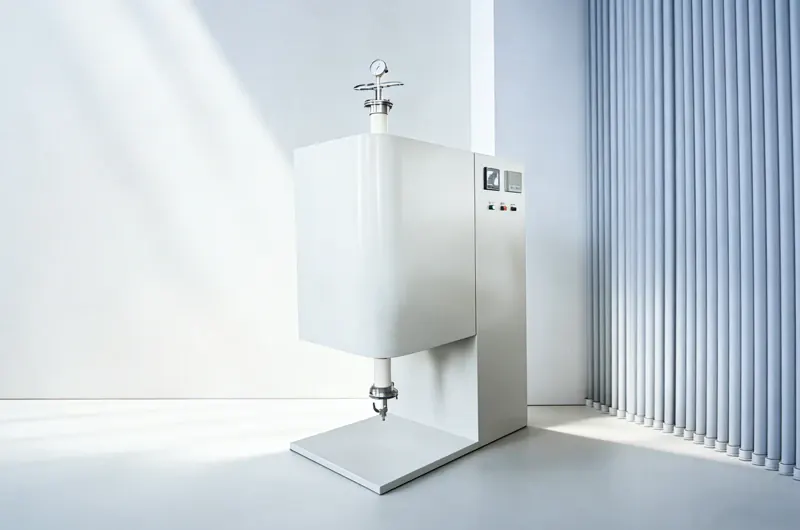
Factory Manufacturer
Designed, assembled and tested by Brother Furnace engineering team.
Brother vertical tube furnace adopts a high purity quartz tube or high purity alumina tube according to different working temperatures. The furnace tube is assembled with stainless steel vacuum sealing flanges, allowing the furnace to operate under vacuum, flowing inert gas or controlled atmosphere conditions.
This furnace is suitable for rapid heating experiments, quenching tests, temperature measurement, thermocouple calibration, material sintering, gas-solid reaction, CVD research and laboratory heat treatment. When equipped with a sample lifting or moving device, samples can be quickly moved into or out of the heating zone for fast heating or quenching tests.
The equipment combines vertical tube heating, programmable temperature control, reliable sealing, vacuum/gas atmosphere compatibility and optional sample movement design for demanding laboratory processes.
Resistance wire, SiC heater and MoSi2 heating systems are available for different temperature levels.
Automatic program control supports heating, holding and cooling curves for repeatable experiments.
Double-layer steel shell with dual cooling fans helps improve heat insulation and reduce shell temperature.
Double sealing flange design supports vacuum and gas atmosphere processing inside the vertical furnace tube.
Brother Furnace supplies 1200°C, 1400°C and 1600°C vertical tube furnace series. Each series uses a suitable heating element, thermocouple and tube material according to the working temperature.
HRE Fe-Cr-Al-Mo resistance wire heating
Silicon carbide heater
MoSi2 heating element
Compared with horizontal tube furnaces, vertical tube furnaces are more suitable for vertical gas flow, rapid sample movement, temperature measurement, CVD research and special heating processes where samples need to be inserted or removed from the hot zone quickly.
The vertical tube design is not only a different installation direction. It provides special process advantages for gas flow, sample movement, compact installation and temperature testing applications.
The vertical tube direction supports top-down or bottom-up gas flow, making it suitable for CVD, gas-solid reaction and atmosphere experiments.
An optional sample lifting or moving mechanism can help samples enter or leave the hot zone quickly for fast heating and quenching tests.
The vertical layout saves horizontal floor space and is suitable for laboratories with limited bench or floor area but sufficient installation height.
The structure is suitable for temperature measurement, thermocouple calibration and sample tests requiring controlled vertical positioning.
The vertical tube furnace can be used under vacuum, flowing inert gas or controlled atmosphere conditions. Standard mechanical pump vacuum and optional high vacuum system should be selected according to actual process requirements.
The furnace can be equipped with a vacuum pump, vacuum sealing flange and vacuum gauge. Standard mechanical pump vacuum can reach up to -0.1MPa.
Optional molecular pump system is available for high vacuum applications, with ultimate vacuum up to 7×10⁻⁴Pa under suitable system conditions.
Nitrogen, argon or other inert gas can be introduced into the tube chamber for protected atmosphere processing.
Float flowmeters or mass flow controllers can be selected for simple gas control or more accurate gas flow management.
For hydrogen or flammable gas applications, additional safety interlocks, purging procedure and exhaust protection should be configured.
Stainless steel sealing flanges and adjustable flange support structures help improve sealing stability and extend furnace tube service life.
The furnace is designed for safe, reliable and easy operation, with automatic programmable control, temperature protection, electrical leakage protection and optional touch screen interface.
PID temperature control helps maintain stable process conditions for repeatable laboratory experiments.
Users can set automatic heating, holding and cooling segments according to the required process curve.
A 7-inch HD touch screen can be selected for easier operation, monitoring and process control.
The system can automatically cut off power when furnace temperature exceeds the allowable set value.
The system automatically powers off when electrical leakage is detected, improving equipment safety.
Double-layer steel shell and dual cooling fans help reduce shell temperature and improve operating safety.
Model selection should be based on working temperature, tube diameter, heating zone, atmosphere, vacuum level, sample movement requirement and power supply.
| Working Requirement | Recommended Series | Heating Element | Tube Material |
|---|---|---|---|
| General experiments around 1100°C | 1200°C Series | HRE Fe-Cr-Al-Mo resistance wire | Quartz tube |
| Medium-high temperature around 1300°C | 1400°C Series | SiC heater | Alumina tube |
| High-temperature experiments around 1500°C | 1600°C Series | MoSi2 heater | Alumina tube |
| Selection Item | Available Options | Recommendation |
|---|---|---|
| Tube outer diameter | 40 / 60 / 80 / 100 / 120mm | Select according to sample size, crucible size and gas flow requirement. |
| Heating zone | 300mm / 450mm standard | Choose longer heating zone when a larger constant temperature area is required. |
| Sample movement | Manual or optional lifting device | Choose lifting device for rapid heating, quick removal or quenching tests. |
| Process Condition | Recommended Configuration | Notes |
|---|---|---|
| Basic vacuum | Mechanical pump + vacuum gauge | Suitable for standard vacuum experiments up to -0.1MPa. |
| High vacuum | Molecular pump system | Optional system can reach ultimate vacuum up to 7×10⁻⁴Pa. |
| Controlled gas flow | Flowmeter or mass flow controller | Recommended for nitrogen, argon or multi-gas processes. |
| Hydrogen or flammable gas | Safety interlock and purging protection | Special safety design should be confirmed before quotation. |
Standard models include 1200°C, 1400°C and 1600°C series. Tube diameter, heating zone, vacuum system, atmosphere system, lifting structure and control system can be customized according to customer requirements.
| Model | Tube O.D. × Heating Zone | Power | Max Temp | Work Temp | Thermocouple | Tube Material | Heating Element |
|---|---|---|---|---|---|---|---|
| BR-12NVT-40/300 | 40 × 300mm | 3kW | 1200°C | 1100°C | K Type | Quartz Tube | Resistance Wire |
| BR-12NVT-60/300 | 60 × 300mm | 3kW | 1200°C | 1100°C | K Type | Quartz Tube | Resistance Wire |
| BR-12NVT-80/300 | 80 × 300mm | 5kW | 1200°C | 1100°C | K Type | Quartz Tube | Resistance Wire |
| BR-12NVT-100/300 | 100 × 300mm | 5kW | 1200°C | 1100°C | K Type | Quartz Tube | Resistance Wire |
| BR-12NVT-120/300 | 120 × 300mm | 6kW | 1200°C | 1100°C | K Type | Quartz Tube | Resistance Wire |
| BR-12NVT-40/450 | 40 × 450mm | 3kW | 1200°C | 1100°C | K Type | Quartz Tube | Resistance Wire |
| BR-12NVT-60/450 | 60 × 450mm | 3kW | 1200°C | 1100°C | K Type | Quartz Tube | Resistance Wire |
| BR-12NVT-80/450 | 80 × 450mm | 5kW | 1200°C | 1100°C | K Type | Quartz Tube | Resistance Wire |
| BR-12NVT-100/450 | 100 × 450mm | 5kW | 1200°C | 1100°C | K Type | Quartz Tube | Resistance Wire |
| BR-12NVT-120/450 | 120 × 450mm | 6kW | 1200°C | 1100°C | K Type | Quartz Tube | Resistance Wire |
| Model | Tube O.D. × Heating Zone | Power | Max Temp | Work Temp | Thermocouple | Tube Material | Heating Element |
|---|---|---|---|---|---|---|---|
| BR-14SVT-40/300 | 40 × 300mm | 4kW | 1400°C | 1300°C | S Type | Alumina Tube | SiC Heater |
| BR-14SVT-60/300 | 60 × 300mm | 4kW | 1400°C | 1300°C | S Type | Alumina Tube | SiC Heater |
| BR-14SVT-80/300 | 80 × 300mm | 4kW | 1400°C | 1300°C | S Type | Alumina Tube | SiC Heater |
| BR-14SVT-100/300 | 100 × 300mm | 6kW | 1400°C | 1300°C | S Type | Alumina Tube | SiC Heater |
| BR-14SVT-120/300 | 120 × 300mm | 6kW | 1400°C | 1300°C | S Type | Alumina Tube | SiC Heater |
| BR-14SVT-40/450 | 40 × 450mm | 4kW | 1400°C | 1300°C | S Type | Alumina Tube | SiC Heater |
| BR-14SVT-60/450 | 60 × 450mm | 4kW | 1400°C | 1300°C | S Type | Alumina Tube | SiC Heater |
| BR-14SVT-80/450 | 80 × 450mm | 4kW | 1400°C | 1300°C | S Type | Alumina Tube | SiC Heater |
| BR-14SVT-100/450 | 100 × 450mm | 6kW | 1400°C | 1300°C | S Type | Alumina Tube | SiC Heater |
| BR-14SVT-120/450 | 120 × 450mm | 6kW | 1400°C | 1300°C | S Type | Alumina Tube | SiC Heater |
| Model | Tube O.D. × Heating Zone | Power | Max Temp | Work Temp | Thermocouple | Tube Material | Heating Element |
|---|---|---|---|---|---|---|---|
| BR-16MVT-40/300 | 40 × 300mm | 4kW | 1600°C | 1500°C | B Type | Alumina Tube | MoSi2 Heater |
| BR-16MVT-60/300 | 60 × 300mm | 4kW | 1600°C | 1500°C | B Type | Alumina Tube | MoSi2 Heater |
| BR-16MVT-80/300 | 80 × 300mm | 4kW | 1600°C | 1500°C | B Type | Alumina Tube | MoSi2 Heater |
| BR-16MVT-100/300 | 100 × 300mm | 6kW | 1600°C | 1500°C | B Type | Alumina Tube | MoSi2 Heater |
| BR-16MVT-120/300 | 120 × 300mm | 6kW | 1600°C | 1500°C | B Type | Alumina Tube | MoSi2 Heater |
| BR-16MVT-40/450 | 40 × 450mm | 5kW | 1600°C | 1500°C | B Type | Alumina Tube | MoSi2 Heater |
| BR-16MVT-60/450 | 60 × 450mm | 5kW | 1600°C | 1500°C | B Type | Alumina Tube | MoSi2 Heater |
| BR-16MVT-80/450 | 80 × 450mm | 5kW | 1600°C | 1500°C | B Type | Alumina Tube | MoSi2 Heater |
| BR-16MVT-100/450 | 100 × 450mm | 9kW | 1600°C | 1500°C | B Type | Alumina Tube | MoSi2 Heater |
| BR-16MVT-120/450 | 120 × 450mm | 9kW | 1600°C | 1500°C | B Type | Alumina Tube | MoSi2 Heater |
To avoid configuration misunderstanding, standard parts and optional accessories are listed separately. Vacuum pump and high vacuum system can be supplied according to quotation scope and process requirements.
Please provide the following process details so our engineers can recommend the right furnace model, tube size, vacuum system, gas system and accessories.
Required maximum temperature and continuous working temperature.
Required tube diameter, tube length and heating zone length.
Sample size, loading weight, crucible size or sample holder requirement.
Gas type, gas flow direction, gas flow rate and gas purity requirement.
Standard vacuum, high vacuum or molecular pump system requirement.
Whether a lifting device or rapid quenching structure is needed.
Standard controller, touch screen, data logging or communication interface.
Hydrogen, flammable gas, exhaust, purging and interlock requirements.
Voltage, phase, frequency and local electrical standard.
Destination country, delivery requirement and installation environment.
Brother Furnace helps customers confirm process requirements, select suitable configurations, complete production testing and receive after-sales technical support.
We review temperature, tube size, atmosphere, vacuum level, sample movement and safety needs.
A standard or customized vertical tube furnace configuration is recommended.
The furnace is assembled, wired, inspected and tested before shipment.
Export packing, operation documents, remote installation guidance and spare parts support are provided.
Answers to the questions our customers ask most often about the vacuum tungsten wire sintering furnace.
A vertical tube furnace has a vertically installed tube chamber, making it more suitable for vertical gas flow, sample lifting, rapid sample insertion/removal, quenching tests, CVD research and temperature measurement. A horizontal tube furnace is more common for general sample heating, sintering and horizontal gas flow experiments.
The furnace can support rapid heating or quenching test applications when equipped with a sample lifting or moving device. If you need true fast quenching, please confirm sample size, movement method, cooling area and atmosphere requirement before quotation.
Yes. The furnace can be equipped with stainless steel sealing flanges, vacuum gauge and vacuum pump. Standard mechanical pump vacuum can reach up to -0.1MPa, while optional molecular pump system can reach higher vacuum levels.
The molecular pump system is an optional high vacuum configuration. It is recommended only when the process requires high vacuum conditions, such as certain material research, CVD or special heat treatment applications.
Quartz tube is normally used for the 1200°C series with recommended working temperature around 1100°C. Alumina tube is recommended for 1400°C and 1600°C series because it provides better high-temperature stability.
Nitrogen and argon are common inert gas options. Hydrogen or flammable gas applications require additional safety design, including purging, exhaust protection and safety interlocks. Please provide gas type and flow rate before quotation.
Yes. Standard tube outer diameters include 40mm, 60mm, 80mm, 100mm and 120mm. Standard heating zones include 300mm and 450mm. Other tube sizes and heating zone lengths can be customized according to sample and process requirements.
Please provide maximum temperature, working temperature, tube diameter, heating zone, sample size, vacuum level, atmosphere gas, gas flow rate, whether sample lifting is needed, power supply and destination country.
The furnace is suitable for laboratories, research institutes and industrial facilities that require precise high-temperature processing in a vertical tube chamber.