
Factory Manufacturer
Designed, assembled and tested by Brother Furnace engineering team.
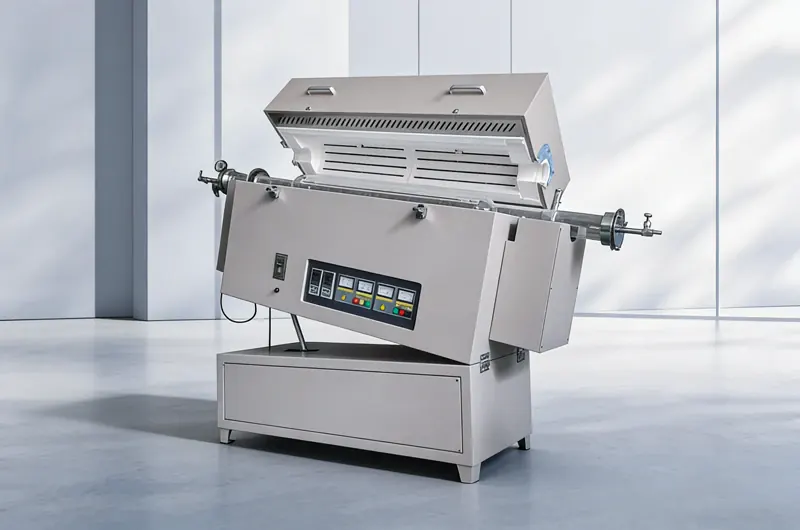
BR-12NRT rotary tube furnace is designed for calcining inorganic compounds with better uniformity. It is especially suitable for R&D laboratories working on lithium-ion battery cathode materials, carbon-coated powders, catalyst powders, ceramic powders and other functional inorganic materials.
Compared with a static horizontal tube furnace, the rotary tube furnace continuously turns the material bed during heating. The quartz tube rotates at adjustable speed, while quartz lifting plates on the inner wall help powders tumble and mix more completely. This improves heating uniformity, gas-solid contact and coating consistency.
The BR-12NRT series combines powder rotation, controlled heating, adjustable inclination and safety protection for laboratory calcination, coating, reduction and gas-solid reaction processes.
Recommended working temperature up to 1100°C for powder calcination and laboratory thermal processing.
Programmable automatic temperature control supports heating, holding and cooling process curves.
Variable tube rotation speed helps control powder mixing intensity and residence behavior.
Cover opening protection, over-temperature alarm and electrical leakage protection improve operation safety.
For battery material R&D, powder uniformity, conductive coating quality, heating consistency and atmosphere control are critical. The rotary tube design helps improve these process conditions.
For carbon coating and surface modification of active material powders.
For laboratory calcination and thermal processing of cathode materials.
For powder reactions requiring atmosphere flow and material movement.
This furnace is suitable for laboratory research and small batch experiments where powders need dynamic heating, mixing, coating or gas-solid reaction during thermal treatment.
The furnace works by combining controlled heating, tube rotation, powder lifting, adjustable inclination and gas atmosphere flow to improve calcination uniformity and material reaction quality.
Powder or granules are loaded into the quartz rotary tube manually or through optional feeding accessories.
The tube rotates at 0–10 RPM, and internal lifting plates repeatedly turn the material bed.
The 50-segment PID controller manages heating, holding and cooling curves accurately.
Optional gas flow or vacuum system supports air, inert gas or controlled atmosphere processes.
After processing, material can be discharged by tilt angle adjustment or collected through optional discharge parts.
The rotary tube furnace allows users to adjust rotation speed, rotation direction and tube inclination according to powder flowability, processing time, loading amount and reaction requirements.
Variable tube rotation speed helps match different powder densities, particle sizes and mixing requirements.
Forward and reverse rotation can support more flexible material movement and discharge operation.
Adjustable furnace inclination helps loading, unloading and material residence time control.
Internal lifting plates lift and drop powder during rotation, helping materials fully turn over and heat evenly.
The BR-12NRT rotary tube furnace can be configured for standard vacuum, inert gas atmosphere or controlled gas flow processes. For reducing or flammable gases, additional safety design should be confirmed before quotation.
Vacuum flange, vacuum pressure gauge and vacuum pump can be supplied according to the quotation scope and process needs.
Nitrogen or argon can be introduced for protected atmosphere calcination, coating and powder thermal processing.
Float flowmeter or mass flow controller can be selected when gas flow accuracy and repeatability are required.
Rotary sealing and flange design help maintain atmosphere protection while the process tube is rotating.
For hydrogen-containing or flammable gas applications, purging, exhaust and safety interlock designs are recommended.
Powder calcination may generate gas, vapor or fine particles, so exhaust connection and collection should be planned.
Rotary tube furnace configuration depends strongly on the material form and operation mode. Manual batch loading is suitable for simple laboratory use, while feeding and collection accessories can support semi-continuous experiments.
The furnace is designed for laboratory users who need accurate temperature control, repeatable heating curves, real-time observation and safety protection during high-temperature rotary operation.
Programmable PID automatic control supports multi-step heating, holding and cooling profiles.
Accurate temperature control helps improve repeatability in powder calcination and coating experiments.
The upper open furnace cover design allows easier observation and maintenance of the heating area.
Power-off protection can be configured when the furnace cover is opened for safer operation.
The system provides over-temperature alarm and protection when the temperature exceeds the allowed setting.
Leakage protection helps reduce electrical risks during high-temperature laboratory operation.
Rotary tube furnace selection should consider powder properties, tube size, heating zone, required capacity, residence time, rotation speed, tilt angle, atmosphere and feeding method.
| Material Information | Why It Matters | Selection Notes |
|---|---|---|
| Powder name and chemical composition | Determines tube compatibility and atmosphere requirements. | Quartz tube is standard; special materials may need compatibility review. |
| Particle size and bulk density | Affects mixing behavior, residence time and loading amount. | Fine powders may require dust collection or sealed discharge design. |
| Flowability and stickiness | Affects rotation speed, tilt angle and discharge performance. | Sticky or agglomerating powders should be tested before scale-up. |
| Reaction gas or vapor release | Affects exhaust, pressure and safety design. | Provide gas release information for exhaust configuration. |
| Tube Model | Thin End Diameter | Heating Zone | Thick End Diameter | Typical Use |
|---|---|---|---|---|
| 60mm Series | 60mm | 300 / 450mm | 120mm | Small sample R&D and powder screening tests. |
| 80mm Series | 80mm | 300 / 450mm | 150mm | General laboratory powder calcination experiments. |
| 100mm Series | 100mm | 300 / 450mm | 180mm | Larger laboratory batches and battery material research. |
| 150mm Series | 150mm | 300 / 450mm | 200mm | Higher loading experiments and small pilot-scale trials. |
| Process Requirement | Recommended Configuration | Notes |
|---|---|---|
| Batch powder calcination | Standard rotary tube furnace | Manual loading and tilt-assisted unloading are usually sufficient. |
| Atmosphere calcination | Gas inlet/outlet + flowmeter | Use nitrogen, argon, air or oxygen depending on process. |
| Coating or reduction process | Controlled atmosphere + safety package | Hydrogen-containing gases require special safety confirmation. |
| Semi-continuous processing | Feeding hopper + collection bottle | Processing capacity depends on material flowability and residence time. |
The BR-12NRT series is a 1200°C rotary tube furnace with quartz tube, resistance wire heating and K type thermocouple. Standard heating zones include 300mm and 450mm, with multiple tube sizes for different laboratory processing needs.
| Model | Thin End Dia. × Heating Zone | Thick End Dia. | Power | Max Temp | Work Temp | Thermocouple | Tube Material | Heating Element |
|---|---|---|---|---|---|---|---|---|
| BR-12NRT-60/300 | 60 × 300mm | 120mm | 5kW | 1200°C | 1100°C | K Type | Quartz Tube | Resistance Wire |
| BR-12NRT-60/450 | 60 × 450mm | 120mm | 5kW | 1200°C | 1100°C | K Type | Quartz Tube | Resistance Wire |
| BR-12NRT-80/300 | 80 × 300mm | 150mm | 5kW | 1200°C | 1100°C | K Type | Quartz Tube | Resistance Wire |
| BR-12NRT-80/450 | 80 × 450mm | 150mm | 5kW | 1200°C | 1100°C | K Type | Quartz Tube | Resistance Wire |
| BR-12NRT-100/300 | 100 × 300mm | 180mm | 7kW | 1200°C | 1100°C | K Type | Quartz Tube | Resistance Wire |
| BR-12NRT-100/450 | 100 × 450mm | 180mm | 7kW | 1200°C | 1100°C | K Type | Quartz Tube | Resistance Wire |
| BR-12NRT-150/300 | 150 × 300mm | 200mm | 9kW | 1200°C | 1100°C | K Type | Quartz Tube | Resistance Wire |
| BR-12NRT-150/450 | 150 × 450mm | 200mm | 9kW | 1200°C | 1100°C | K Type | Quartz Tube | Resistance Wire |
Rotary tube furnace selection depends heavily on powder properties and process conditions. Please provide the following details so our engineers can recommend the correct model and configuration.
Chemical composition and material type.
Powder size range, flowability and dust level.
Used to estimate loading amount and capacity.
Maximum and continuous working temperature.
Required holding time or material residence time.
Batch loading amount or hourly processing target.
Air, oxygen, nitrogen, argon or reducing gas.
Batch, semi-continuous or continuous feeding.
Voltage, phase, frequency and local standard.
Country, delivery requirement and installation space.
Brother Furnace helps customers confirm material requirements, select suitable tube size, configure atmosphere and feeding accessories, then complete production and testing before shipment.
We review powder type, particle size, density, capacity, atmosphere and temperature requirements.
A suitable tube size, heating zone, feeding method and gas system are recommended.
The furnace is assembled, wired, checked and tested before shipment.
Export packing, operation documents, remote support and spare parts supply are provided.
Answers to the questions our customers ask most often about the vacuum tungsten wire sintering furnace.
A rotary tube furnace has a rotating process tube, so powders and granules are continuously turned during heating. It is better for powder calcination, coating, catalyst roasting and gas-solid reactions. A horizontal tube furnace usually keeps the sample static in a boat or crucible.
Yes. The BR-12NRT rotary tube furnace is suitable for R&D work on lithium battery cathode powders, including LiFePO₄ conductive coating research, NMC/NCM powder processing and inorganic compound calcination.
The maximum temperature is 1200°C, and the recommended working temperature is 1100°C. The furnace uses resistance wire heating and K type thermocouple.
Yes. The tube rotation speed is adjustable from 0 to 10 RPM and reversible. Users can adjust rotation speed according to powder flowability, mixing requirement and processing target.
The furnace body or tube inclination can be adjusted from 0 to 30 degrees. This helps loading, unloading and residence time control. The correct angle depends on powder flowability and desired processing time.
Yes. The furnace can be equipped with vacuum flange, vacuum pump, vacuum gauge and gas inlet/outlet system. Nitrogen or argon atmosphere can be configured for protected powder processing.
The standard furnace is suitable for laboratory batch or semi-continuous tests. Optional feeding hopper, screw feeder and collection bottle can be configured for semi-continuous powder feeding and discharging experiments.
Tube size should be selected according to powder density, loading amount, residence time, desired capacity, gas flow and process temperature. Please provide your material details and target capacity so our engineers can recommend a suitable model.
We can customize tube size, feeding method, gas flow, collection design, control system and power supply based on your powder material and process target.