
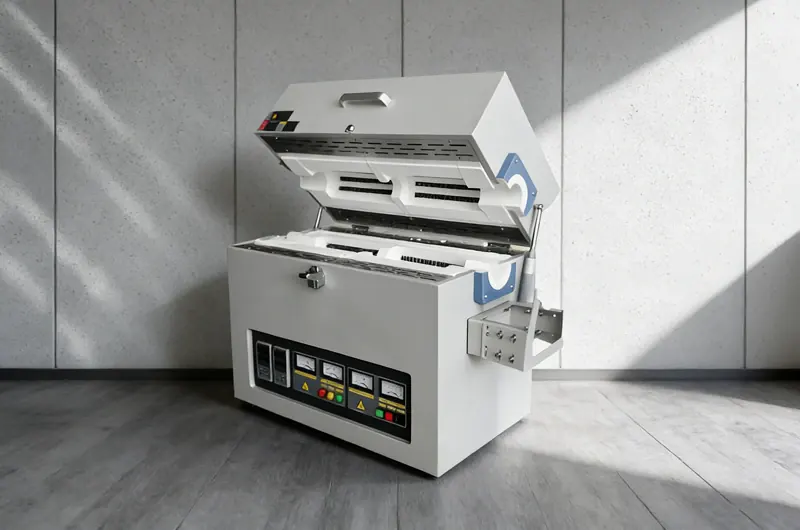
Factory Manufacturer
Designed, assembled and tested by Brother Furnace engineering team.
Brother multi-zone tube furnace can be designed with double heating zones, three heating zones or five heating zones. Each zone can be independently controlled, allowing users to set the same temperature for a long uniform area or different temperatures for gradient experiments.
The furnace is mainly used under vacuum or protective atmosphere for pre-burning, sintering, coating, high-temperature pyrolysis, low-temperature deposition, CVD processes, carbon nanotube preparation and silicon nanowire growth. It is widely used in universities, research institutes, semiconductor laboratories, nanomaterial research centers and industrial R&D facilities.
The equipment combines independent zone control, improved temperature uniformity, long heating area, vacuum/gas atmosphere compatibility and flexible customization for demanding laboratory processes.
Double, three and five heating zone structures can be configured according to process length and temperature profile.
Each zone uses independent temperature control for uniform heating, gradient control or heat-loss compensation.
Multi-zone design helps obtain a longer usable uniform temperature zone for long samples or CVD processes.
Suitable for coating, low-temperature deposition, pyrolysis, nanotube growth and gas-solid reaction experiments.
Brother Furnace supplies 1200°C, 1400°C and 1600°C multi-zone tube furnace series. Each series uses a suitable heating element, thermocouple and tube material according to the working temperature.
Resistance wire heating with quartz tube
Silicon carbide heater with alumina tube
MoSi2 heating element with alumina tube
Different heating zone quantities are selected according to required temperature uniformity, heating length, gradient profile and process complexity.
Basic multi-zone design for dual-temperature control
Most common design for long uniform heating
Advanced structure for long tubes and complex profiles
This furnace is suitable for high-temperature material processes requiring long uniform heating, temperature gradient control, vacuum processing or controlled atmosphere reaction.
The multi-zone design is not only a longer furnace body. It gives users better control over temperature uniformity, gradient heating, process repeatability and gas reaction conditions.
Multiple heating zones can extend the usable uniform temperature area for long samples or long reaction sections.
Different zone setpoints can create controlled temperature gradients for CVD, crystal growth and gas reaction studies.
End zones can compensate heat loss near tube ends, improving the stability of the central heating area.
The furnace supports uniform heating, staged heating, gradient profiles and atmosphere reaction processes.
Multi-zone temperature control is especially useful for CVD processes and nanomaterial research where precursor evaporation, gas reaction, deposition and growth zones may require different temperature conditions.
For catalyst-assisted CNT growth experiments
For silicon nanowire preparation and deposition studies
For multi-stage reaction and coating processes
The multi-zone tube furnace can be used under vacuum, inert gas, oxidizing atmosphere, reducing atmosphere or multi-gas CVD conditions. Gas control should be selected according to material and process safety requirements.
Vacuum pump, vacuum flange and vacuum gauge can be supplied for basic vacuum experiments.
High vacuum system can be configured when the process requires lower pressure or special deposition conditions.
Nitrogen, argon or other inert gases can be introduced for protective atmosphere processing.
Float flowmeters or mass flow controllers can be selected for precise gas flow management.
Multi-channel gas control can be configured for CVD, gas reaction and deposition processes.
Hydrogen or flammable gas applications require purging, exhaust and safety interlock design.
The furnace can be configured with multi-channel temperature control, independent thermocouples, programmable curves, optional touch screen and safety protection for each zone.
Each heating zone can be independently controlled to create uniform or gradient temperature profiles.
Heating, holding and cooling programs can be set according to material process requirements.
Each zone uses its own thermocouple and control loop according to the zone configuration.
PLC touch screen, data recording and communication interface can be added for advanced operation.
Over-temperature alarm and protection can be configured for safer high-temperature operation.
Electrical leakage protection helps reduce operational risks in laboratory and industrial environments.
Standard configuration covers basic multi-zone furnace operation. Optional accessories can be added for CVD, gas control, high vacuum, touch screen, data recording and special safety requirements.
The following tables show standard 2-zone models. 3-zone and 5-zone models can be customized according to required tube diameter, heating length, uniform zone and temperature gradient design.
| Model | Tube O.D. × Heating Zone | Power | Max Temp | Work Temp | Heating Zone | Thermocouple | Tube Material | Heating Element |
|---|---|---|---|---|---|---|---|---|
| BR-12NT-40/220-2 | 40 × 220 × 220mm | 5kW | 1200°C | 1100°C | 2 Zones | K Type | Quartz Tube | Resistance Wire |
| BR-12NT-60/220-2 | 60 × 220 × 220mm | 5kW | 1200°C | 1100°C | 2 Zones | K Type | Quartz Tube | Resistance Wire |
| BR-12NT-80/220-2 | 80 × 220 × 220mm | 6kW | 1200°C | 1100°C | 2 Zones | K Type | Quartz Tube | Resistance Wire |
| BR-12NT-100/300-2 | 100 × 300 × 300mm | 12kW | 1200°C | 1100°C | 2 Zones | K Type | Quartz Tube | Resistance Wire |
| BR-12NT-120/300-2 | 120 × 300 × 300mm | 12kW | 1200°C | 1100°C | 2 Zones | K Type | Quartz Tube | Resistance Wire |
| Model | Tube O.D. × Heating Zone | Power | Max Temp | Work Temp | Heating Zone | Thermocouple | Tube Material | Heating Element |
|---|---|---|---|---|---|---|---|---|
| BR-14ST-40/220-2 | 40 × 220 × 220mm | 5kW | 1400°C | 1300°C | 2 Zones | S Type | Alumina Tube | SiC Heater |
| BR-14ST-60/220-2 | 60 × 220 × 220mm | 5kW | 1400°C | 1300°C | 2 Zones | S Type | Alumina Tube | SiC Heater |
| BR-14ST-80/220-2 | 80 × 220 × 220mm | 6kW | 1400°C | 1300°C | 2 Zones | S Type | Alumina Tube | SiC Heater |
| BR-14ST-100/300-2 | 100 × 300 × 300mm | 12kW | 1400°C | 1300°C | 2 Zones | S Type | Alumina Tube | SiC Heater |
| BR-14ST-120/300-2 | 120 × 300 × 300mm | 12kW | 1400°C | 1300°C | 2 Zones | S Type | Alumina Tube | SiC Heater |
| Model | Tube O.D. × Heating Zone | Power | Max Temp | Work Temp | Heating Zone | Thermocouple | Tube Material | Heating Element |
|---|---|---|---|---|---|---|---|---|
| BR-16MT-40/220-2 | 40 × 220 × 220mm | 6kW | 1600°C | 1500°C | 2 Zones | B Type | Alumina Tube | MoSi2 Heater |
| BR-16MT-60/220-2 | 60 × 220 × 220mm | 6kW | 1600°C | 1500°C | 2 Zones | B Type | Alumina Tube | MoSi2 Heater |
| BR-16MT-80/220-2 | 80 × 220 × 220mm | 6kW | 1600°C | 1500°C | 2 Zones | B Type | Alumina Tube | MoSi2 Heater |
| BR-16MT-100/300-2 | 100 × 300 × 300mm | 12kW | 1600°C | 1500°C | 2 Zones | B Type | Alumina Tube | MoSi2 Heater |
| BR-16MT-120/300-2 | 120 × 300 × 300mm | 12kW | 1600°C | 1500°C | 2 Zones | B Type | Alumina Tube | MoSi2 Heater |
| Parameter Note | Explanation |
|---|---|
| 40 × 220 × 220mm | Means 40mm tube outer diameter with two independent heating zones, each heating zone length is 220mm. |
| 3-Zone / 5-Zone Models | Can be customized based on required heating length, constant temperature zone, temperature uniformity and gradient design. |
| Temperature Uniformity | Depends on tube diameter, heating zone length, number of zones, working temperature and sample loading. Temperature mapping can be provided upon request. |
Model selection should be based on working temperature, number of heating zones, heating zone length, uniform temperature area, gradient requirement, atmosphere, vacuum level and CVD process conditions.
| Process Requirement | Recommended Zone Design | Selection Notes |
|---|---|---|
| Basic dual-temperature experiment | 2-Zone Tube Furnace | Suitable for simple temperature gradient or two-step heating processes. |
| Long constant temperature zone | 3-Zone Tube Furnace | Most common option; end zones compensate heat loss and improve central uniformity. |
| Long tube and complex profile | 5-Zone Tube Furnace | Recommended for advanced gradient, long heating area and complex CVD processes. |
| Custom gradient design | Customized multi-zone layout | Provide desired zone temperatures, heating length and process target before quotation. |
| Selection Item | Available Options | Recommendation |
|---|---|---|
| Temperature Level | 1200°C / 1400°C / 1600°C | Select according to continuous working temperature and process atmosphere. |
| Tube Material | Quartz tube / alumina tube | Quartz tube for 1200°C series; alumina tube for 1400°C and 1600°C series. |
| Tube Outer Diameter | 40 / 60 / 80 / 100 / 120mm or custom | Select according to sample size, boat size and gas flow requirement. |
| Heating Zone Length | 220mm / 300mm per zone or custom | Longer heating length is recommended for larger uniform zone or long samples. |
| Process Condition | Recommended Configuration | Notes |
|---|---|---|
| Basic Vacuum | Mechanical pump + vacuum gauge | Suitable for standard vacuum heat treatment and research processes. |
| Protective Atmosphere | Nitrogen / argon + flowmeter | Recommended for oxidation-sensitive materials. |
| CVD Process | Multi-gas system + mass flow controllers | Recommended for deposition, nanotube growth and gas reaction processes. |
| Hydrogen or Reducing Gas | Safety interlock, purging and exhaust protection | Special safety design should be confirmed before quotation. |
Please provide the following process details so our engineers can recommend the right furnace model, zone layout, tube size, vacuum system, gas system and accessories.
Required maximum temperature and continuous working temperature.
Required 2-zone, 3-zone, 5-zone or custom heating zone layout.
Required heating zone length for each zone and total heated length.
Required constant temperature zone and temperature uniformity target.
Whether temperature gradient control or different zone setpoints are needed.
Tube diameter, tube length, tube material and sample loading requirement.
Vacuum, nitrogen, argon, oxygen, hydrogen or CVD process gas.
Flowmeter, mass flow controller or multi-gas mixing requirement.
Voltage, phase, frequency and local electrical standard.
Destination country, delivery requirement and installation environment.
Brother Furnace helps customers confirm zone layout, temperature profile, CVD requirements, gas control and safety configuration before production and testing.
We review temperature, zone quantity, heating length, uniformity, gradient, vacuum and atmosphere needs.
A suitable 2-zone, 3-zone, 5-zone or custom multi-zone furnace configuration is recommended.
The furnace is assembled, wired, inspected and tested before shipment.
Export packing, operation documents, remote installation guidance and spare parts support are provided.
The furnace is suitable for laboratories, research institutes and industrial facilities that require precise multi-zone heating, CVD processing and temperature gradient research.
Here are common questions customers ask before purchasing a multi-zone tube furnace for CVD, sintering, coating and temperature gradient research.
A multi-zone tube furnace has two or more independently controlled heating zones. It can provide a longer constant temperature zone, better temperature uniformity or a controlled temperature gradient. A single-zone tube furnace has only one heating control area and is better for basic heating applications.
A 2-zone furnace is suitable for simple gradient or dual-temperature processes. A 3-zone furnace is commonly used to create a longer and more stable constant temperature zone. A 5-zone furnace is recommended for long tubes, complex temperature profiles and advanced CVD or gradient experiments.
Yes. Each heating zone can have its own thermocouple and temperature control loop, allowing users to set the same temperature for uniform heating or different temperatures for gradient processes.
Yes. Multi-zone tube furnaces are suitable for low-temperature deposition, gas-solid reaction, carbon nanotube growth, silicon nanowire preparation and other CVD processes. Gas inlet, flowmeter, mass flow controller and multi-gas systems can be configured.
Yes. The furnace can be equipped with vacuum pump, vacuum flange and vacuum gauge. Nitrogen, argon or other process gases can also be introduced through gas flow control systems.
Hydrogen or reducing gas applications require additional safety design, including purging, exhaust protection, gas pressure monitoring and interlocks. Please provide gas type, concentration and flow rate before quotation.
Temperature uniformity depends on tube diameter, heating zone length, working temperature, number of zones and loading condition. Temperature mapping can be provided according to project requirements.
Please provide maximum temperature, working temperature, number of heating zones, heating zone length, tube diameter, required constant temperature zone, temperature gradient requirement, atmosphere gas, vacuum level, gas flow control requirement, power supply and destination country.