
Factory Manufacturer
Designed, assembled and tested by Brother Furnace engineering team.
Brother Furnace fast-cooling tube furnace is developed for laboratories, universities, research institutes and industrial R&D facilities that require quick cooling after high-temperature heating. The furnace can be configured with quartz tube or alumina tube according to temperature level and process atmosphere.
Compared with ordinary tube furnaces that rely mainly on natural cooling, the fast-cooling design can separate the sample from the hot zone more quickly or accelerate heat dissipation through cooling structures. This makes it suitable for rapid thermal processing, thermal cycling tests, fast annealing, quenching experiments, semiconductor materials, ceramic materials, metal alloys, catalyst research and battery material development.
The furnace combines precise heating, fast cooling, reliable sealing, flexible atmosphere control and safety protection for rapid thermal processing and laboratory heat treatment applications.
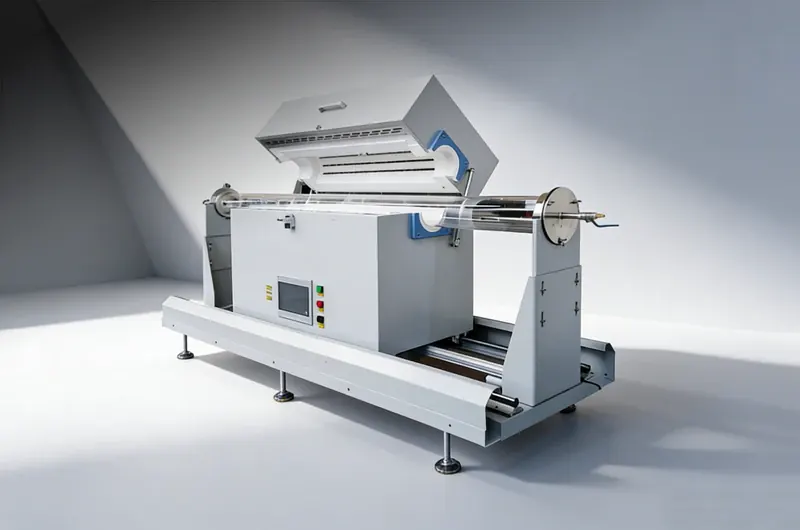
Cooling time can be shortened by sliding the furnace body away from the sample zone or using forced cooling options.
Faster cooling reduces waiting time between experiments and improves daily laboratory testing efficiency.
Multi-segment temperature control supports heating, holding and process repeatability for material research.
Over-temperature, electrical leakage, cooling flow, fan and movement safety protection can be configured.
Different cooling structures can be selected according to target cooling speed, sample size, tube diameter, atmosphere condition and safety requirements.
Movable furnace design for quick heat-zone separation
Fan-assisted cooling for faster heat dissipation
Sealing protection for vacuum and atmosphere systems
This furnace is suitable for material processes that require fast cooling, rapid heat-zone separation, rapid thermal cycling or controlled atmosphere heat treatment.
The fast-cooling structure is designed to shorten cooling time and improve temperature response during laboratory heat treatment, especially when a standard tube furnace cools too slowly for the process.
The movable furnace body can separate the heated furnace section from the sample area faster than natural furnace cooling.
Faster cooling helps reduce unwanted grain growth, over-reaction or long exposure at high temperature.
Shorter heating and cooling cycles make the furnace suitable for repeated testing and rapid process development.
The furnace is suitable for universities and R&D labs that need flexible heating, cooling and atmosphere control.
A standard tube furnace is suitable for general heating and natural cooling, while a fast-cooling tube furnace is better when cooling speed, sample transfer or rapid thermal cycling is important.
| Comparison Item | Fast-Cooling Tube Furnace | Standard Tube Furnace |
|---|---|---|
| Cooling Method | Sliding furnace body, forced cooling, water-cooled flange or cooling zone | Mainly natural cooling inside furnace body |
| Experiment Cycle | Shorter waiting time between experiments | Longer cooling time after heat treatment |
| Best Applications | Rapid annealing, quenching tests, thermal cycling, phase control | General sintering, annealing and atmosphere heating |
| Temperature Response | Faster cooling response and more flexible process control | Slower cooling response |
| Configuration Cost | Higher due to moving/cooling structure | Lower for basic heating applications |
The fast-cooling tube furnace can be used under vacuum, inert gas, oxidizing atmosphere or customized gas atmosphere conditions. The sealing and cooling configuration should be selected according to process temperature and gas type.
Vacuum pump, sealing flange and vacuum gauge can be configured for basic vacuum heat treatment experiments.
Nitrogen, argon or other inert gas can be introduced for oxidation protection during heating and cooling.
Float flowmeter or mass flow controller can be selected for simple or accurate process gas management.
Water-cooled flange is recommended when high temperature and sealing protection are required.
Hydrogen or flammable gas applications require purging, exhaust and safety interlock confirmation.
Stainless steel flanges and proper tube support help maintain sealing stability during heating and cooling.
The furnace is designed for laboratory users who need accurate temperature control, repeatable heating curves, fast cooling operation and safety protection during high-temperature experiments.
Multi-segment PID control supports heating, holding and process curve repeatability.
Accurate temperature control helps improve repeatability in rapid annealing and material testing.
Sliding furnace movement limit switches and rail safety locks can be configured for safer operation.
Cooling fan status and forced cooling operation can be monitored according to configuration.
For water-cooled flange systems, water flow alarm can help protect sealing and cooling components.
The system can alarm or cut off power when temperature exceeds the allowed setting value.
Standard configuration covers basic furnace operation. Optional accessories can be added for rapid cooling, vacuum, atmosphere, data recording and special safety requirements.
Final technical parameters depend on temperature level, tube size, heating zone, cooling method, atmosphere system and customer process requirements.
| Item | Typical Options | Notes |
|---|---|---|
| Maximum Temperature | 1200°C / 1400°C / 1600°C | Selected according to working temperature and tube material. |
| Working Temperature | 1100°C / 1300°C / 1500°C typical | Continuous working temperature should be confirmed before quotation. |
| Tube Material | Quartz tube / alumina tube | Quartz for lower temperature, alumina for higher temperature processes. |
| Tube Diameter | 40 / 60 / 80 / 100 / 120mm or customized | Selected according to sample size and gas flow requirement. |
| Heating Zone | 300mm / 450mm / customized | Longer heating zone can be customized for larger uniform area. |
| Heating Rate | Usually 0–20°C/min | Actual rate depends on furnace size and temperature level. |
| Cooling Method | Sliding furnace / forced air / water-cooled flange / cooling zone | Cooling method should match target cooling time and safety needs. |
| Temperature Accuracy | ±1°C typical | Depends on controller and sensor configuration. |
| Atmosphere | Vacuum, nitrogen, argon, air, oxygen, customized gas | Hydrogen and flammable gas require special safety design. |
| Power Supply | 220V / 380V, single phase / three phase | Customized according to destination country and furnace power. |
Model selection should be based on working temperature, required cooling speed, cooling method, tube size, heating zone, atmosphere, vacuum level, sample loading and safety requirements.
| Cooling Requirement | Recommended Design | Selection Notes |
|---|---|---|
| Shorter natural cooling time | Sliding movable furnace body | Suitable when the sample should leave the hot zone quickly after heating. |
| Faster heat dissipation | Forced air cooling system | Useful for repeated experiments and faster cooling cycles. |
| Sealing protection | Water-cooled flange | Recommended for vacuum or gas processes at higher temperature. |
| Special rapid cooling test | Customized cooling zone or sample transfer design | Provide target cooling time and sample details before quotation. |
| Selection Item | Available Options | Recommendation |
|---|---|---|
| Temperature Level | 1200°C / 1400°C / 1600°C | Select according to continuous working temperature, not only maximum temperature. |
| Tube Material | Quartz tube / alumina tube | Quartz is used for lower temperature; alumina is recommended for higher temperature. |
| Tube Diameter | 40 / 60 / 80 / 100 / 120mm or custom | Select according to sample size, crucible size and gas flow requirement. |
| Heating Zone | 300mm / 450mm / custom | Choose longer heating zone when larger constant temperature area is required. |
| Process Condition | Recommended Configuration | Notes |
|---|---|---|
| Basic Vacuum | Mechanical pump + vacuum gauge | Suitable for standard vacuum experiments. |
| Inert Atmosphere | Nitrogen / argon + flowmeter | Recommended for oxidation-sensitive materials. |
| Precise Gas Control | Mass flow controller | Recommended when gas flow repeatability is important. |
| Hydrogen or Reducing Gas | Safety interlock, purging and exhaust protection | Special safety design should be confirmed before quotation. |
Please provide the following process details so our engineers can recommend the right furnace model, tube size, cooling method, vacuum system, gas system and accessories.
Material type, composition and heat treatment purpose.
Sample dimensions, loading quantity and sample holder requirement.
Required maximum temperature and continuous working temperature.
Required cooling time, target temperature or cooling rate expectation.
Sliding furnace, forced air cooling, water-cooled flange or custom cooling zone.
Tube diameter, tube length and heating zone length.
Vacuum, nitrogen, argon, air, oxygen, hydrogen or other process gas.
Standard controller, touch screen, data logging or communication interface.
Voltage, phase, frequency and local electrical standard.
Destination country, delivery requirement and installation environment.
Brother Furnace helps customers confirm process requirements, select suitable cooling configuration, complete production testing and receive after-sales technical support.
We review temperature, cooling target, tube size, atmosphere, vacuum level and safety needs.
A suitable fast-cooling tube furnace structure and accessory configuration are recommended.
The furnace is assembled, wired, inspected and tested before shipment.
Export packing, operation documents, remote installation guidance and spare parts support are provided.
The furnace is suitable for laboratories, research institutes and industrial facilities that require rapid cooling, controlled atmosphere heating and thermal process development.
Answers to the questions our customers ask most often about the vacuum tungsten wire sintering furnace.
A fast-cooling tube furnace is a tube furnace designed to cool samples faster than a standard furnace after heat treatment. It may use a sliding furnace body, forced air cooling, water-cooled flange or customized cooling zone.
The most common method is to move the furnace body away from the sample heating zone after the process. Forced air cooling, water-cooled flanges and gas-assisted cooling can also be configured according to process needs.
A standard tube furnace usually cools naturally inside the furnace body. A fast-cooling tube furnace is designed to reduce cooling time and support rapid annealing, quenching tests, thermal cycling and temperature-sensitive material studies.
Yes. Vacuum sealing flange, vacuum pump and vacuum gauge can be configured. For higher temperature or repeated cooling cycles, water-cooled flange protection is recommended.
Yes. Nitrogen and argon are common protective gases for oxidation-sensitive materials. Flowmeter or mass flow controller can be selected according to gas flow accuracy requirements.
Cooling rate depends on furnace temperature, tube size, sample loading, atmosphere flow, cooling method and ambient conditions. Please provide your target cooling time or target temperature so we can recommend a suitable configuration.
Yes. Tube diameter, tube length, heating zone, constant temperature zone and cooling structure can be customized according to sample size and process requirements.
Please provide material name, sample size, working temperature, target cooling time, tube size, atmosphere, vacuum requirement, cooling method preference, power supply and destination country.